
Harnessing GenAI and Peer Momentum: Building an Active Learning Spiral in Creative Sound and Video Design
|
Prof. Andrew HORNER is a Professor in the Department of Computer Science and Engineering at the Hong Kong University of Science and Technology (HKUST). His teaching excellence has been recognized by the HKUST Michael G. Gale Medal for Distinguished Teaching 2001, the HKUST Common Core Teaching Excellence Award 2025, and the SENG Teaching Excellence Appreciation Award for seven times. He is also a Senior Fellow of HKUST’s Academy of Education Excellence. He specializes in music technology, computer music, and generative music. His research and pedagogical innovations explore the intersection of generative AI and experiential peer-learning frameworks. |
By Prof. Andrew Horner
Moving beyond spoon-feeding: experiential learning in the age of AI
Teaching Creative Sound and Video Design (COMP1943) at HKUST often feels like guiding students through a high-stakes adventure where they must confront a blank canvas and build something extraordinary. Students are tasked with taking complex digital tools—ranging from standard video and audio editors to cutting-edge generative AI—and fashioning high-impact creative works: movie parody mashups, greenscreen composite remixes, and wacky-twist lyric videos.
In engineering education, discussions around generative AI often focus on academic compliance or tool restrictions. However, when we treat AI as an active hands-on partner rather than a shortcut, it transforms how students learn. Instead of starting with tedious first-principles theory and slogging through basics before writing a single line of code or music, we use open-ended, mission-oriented quests. Students learn by doing—diving straight into creative problem-solving and discovering technical principles organically through trial, error, and creation.
Elevating human intent: GenAI as a co-creator
A central challenge in modern technical education is ensuring that AI tools augment rather than replace human agency. In COMP1943, we establish a core rule early on: the creative vision belongs entirely to the human; GenAI is simply an accelerator.
GenAI has introduced a vibrant “DJ culture” of mixing and matching musical and video elements. Today’s students leverage AI voice separation, chord extraction, deepfake compositing, and text-to-video generators. However, working with raw AI outputs is rarely straightforward; it presents real engineering and design hurdles, such as visual continuity drift, artifacts, and aimless character movement. To overcome these challenges, students learn top-down structural organization—crafting conceptual hooks and utilizing linked AI-generated storyboards to guide spatial and temporal consistency.
In our post-course evaluations, 87% of students reported that GenAI allowed them to accomplish creative goals previously beyond their technical reach, while 83% noted that AI simplified the iterative process. Whether using AI to synthesize stylized vocals or intertwine disparate video universes, students learn that AI tools serve as powerful levers to achieve a single goal: maximizing creative impact (“the WoW factor”).
The active learning spiral and interactive peer momentum
Traditional creative arts courses typically limit class sizes to 10–20 students to allow for close mentorship. COMP1943 scales this model to 60 students per semester—drawing undergraduates from across engineering and diverse university majors. Rather than treating a large class size as an obstacle, we turn scale into our primary pedagogical engine through an Active Learning Spiral.
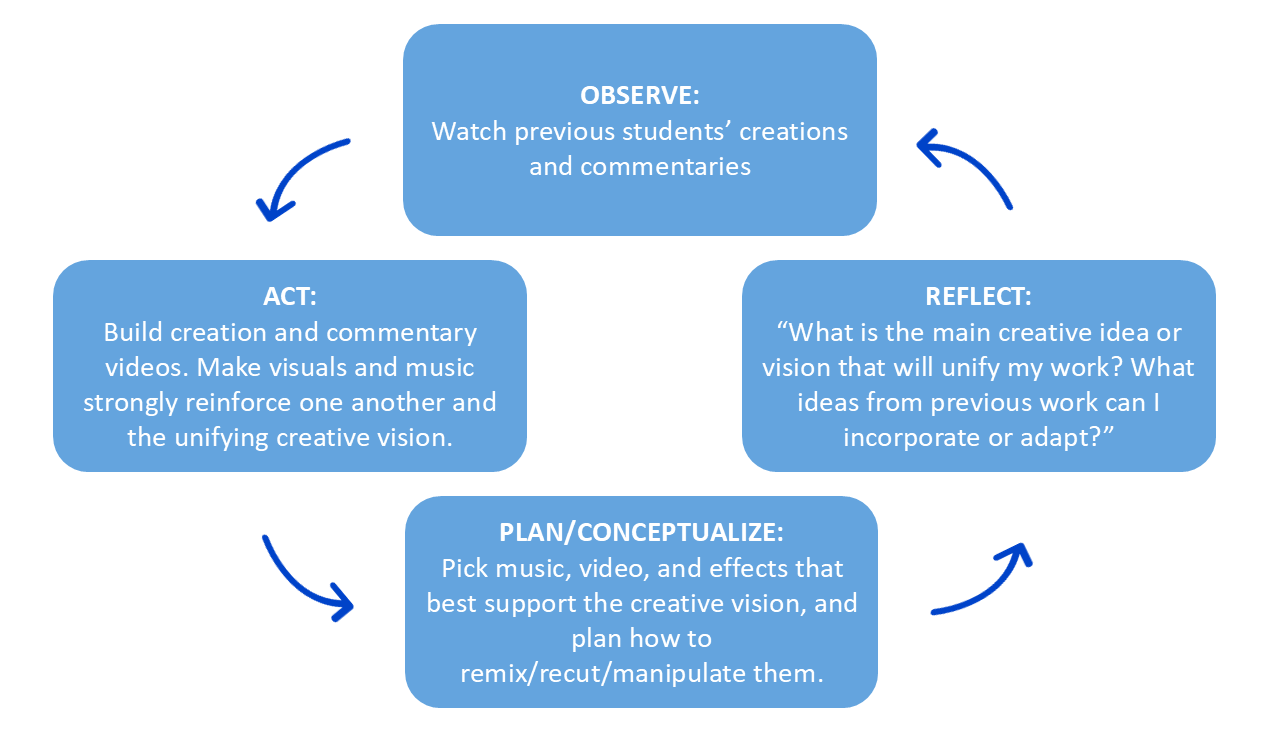
Experiential and active learning cycle in each assignment
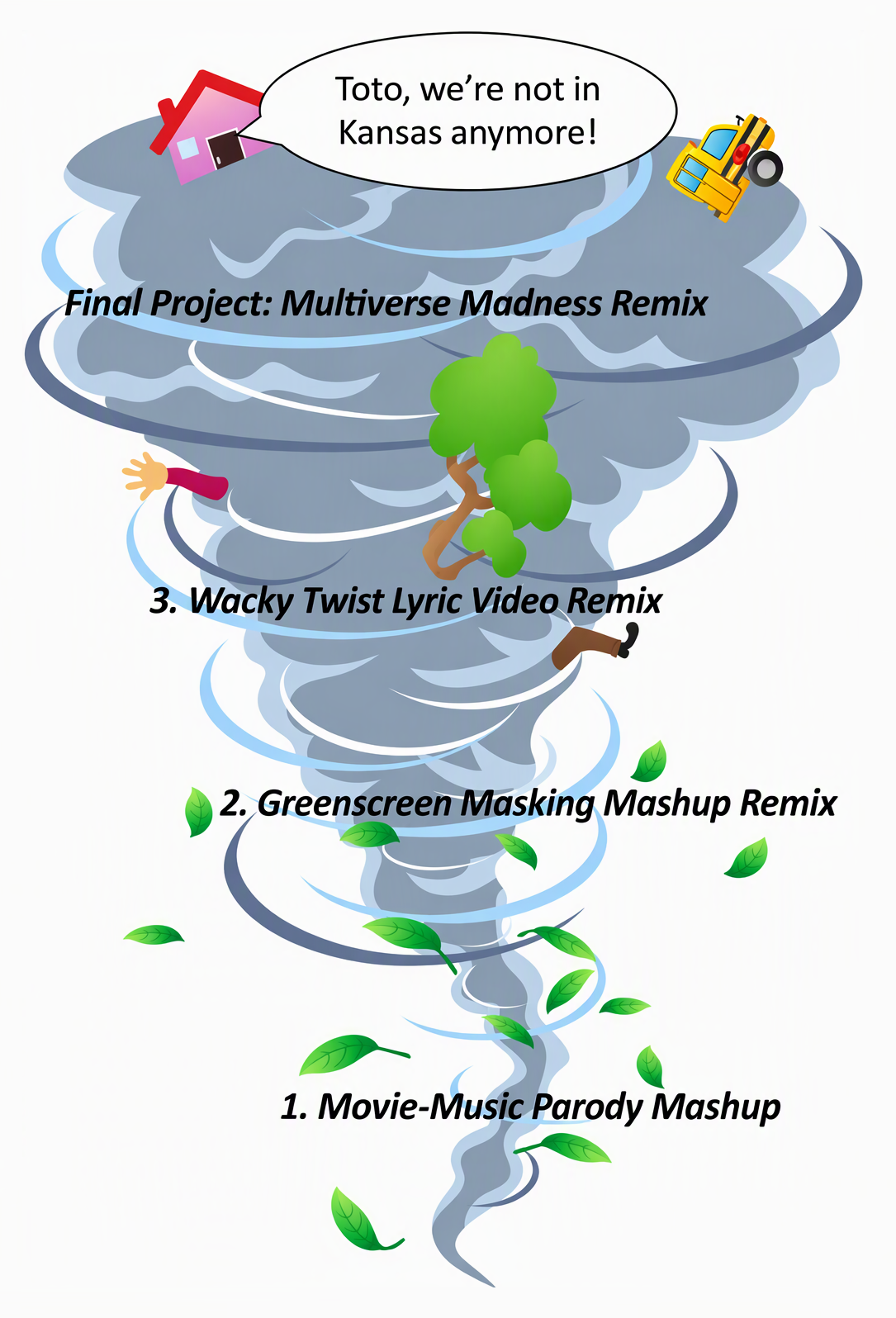
Experiential and active learning spiral created by the assignments and project
Each open-ended mission follows a four-part experiential cycle: Observe, Reflect, Conceptualize, and Act. Because every student approaches the same theme from a unique perspective, a single assignment yields 60 wildly different solutions.
To harness this collective energy, we incorporate two structural mechanisms:
1. Behind-the-Scenes Director Commentaries: Alongside their final cut, every student submits a short documentary-style video explaining what they built, how they built it, and where GenAI assisted versus where human design led.
2. “America’s Got Talent”-Style Peer Feedback: Students actively evaluate and critique their peers’ creations and commentaries during in-class screening sessions.
This structure operates much like an orchestra. The instructor acts as the conductor who sets tempo and direction; TAs function as section leaders providing technical support; and students continuously observe, adapt, and build upon the creative breakthroughs of their peers. Survey data reveals that 94% of students gained actionable insights from observing peer work, while 83% felt directly motivated and inspired by peer feedback. As the semester progresses from initial parody mashups to the final project, student satisfaction scores rise steadily from 3.8 to 4.7 out of 5.
Preparing adaptable engineers for an AI-driven future
Beyond artistic output, this experiential model equips students with vital, transferable professional skills. Producing director commentaries sharpens technical communication and critical self-assessment. Navigating open-ended, ambiguous project requirements fosters out-of-the-box problem-solving abilities—preparing future engineers to tackle complex, real-world challenges where standard formulas fail and innovative breakthroughs are demanded.
Generative AI does not mark the end of rigorous student effort; it marks the beginning of higher-level ambition and design. By embedding GenAI into hands-on, iterative workflows and leveraging large-scale peer learning, we can transform engineering education into an engaging journey of discovery, technical mastery, and creative excellence.