SENG News

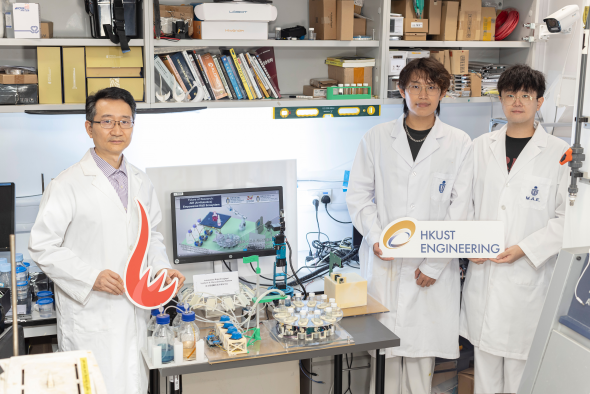
The autonomous high-throughput synthesis and characterization platform placed on the table was developed by a HKUST research team from the Department of Mechanical and Aerospace Engineering. Team members include Prof. Yang Jinglei (first left), Professor of the Department of Mechanical and Aerospace Engineering, PhD student Ma Guoxiong (first right), and MPhil graduate Cui Haozhe (second right).
The autonomous high-throughput synthesis and characterization platform placed on the table was developed by a HKUST research team from the Department of Mechanical and Aerospace Engineering. Team members include Prof. Yang Jinglei (first left), Professor of the Department of Mechanical and Aerospace Engineering, PhD student Ma Guoxiong (first right), and MPhil graduate Cui Haozhe (second right). 
Advancing Materials Research into a New Era of Intelligent Automation
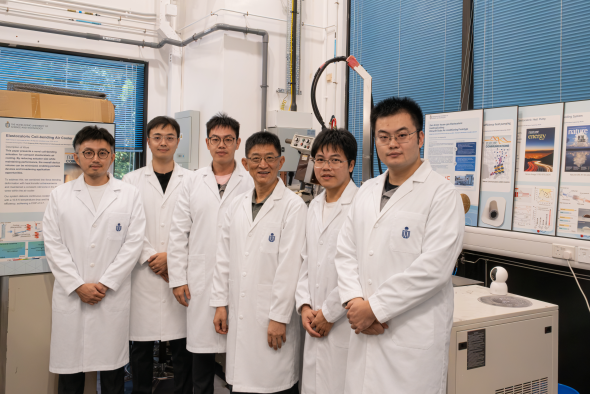
A team led by Prof. Sun Qingping (third right), Chair Professor in the Department of Mechanical and Aerospace Engineering at HKUST, has unveiled the world’s first zero-degradation elastocaloric cooling device. Team members include (from first left) Dr. Li Xueshi, Su Changfeng, Li Yang, (from fifth left) Dr. Lin Hongyang, and Hu Jiyuan.
A team led by Prof. Sun Qingping (third right), Chair Professor in the Department of Mechanical and Aerospace Engineering at HKUST, has unveiled the world’s first zero-degradation elastocaloric cooling device. Team members include (from first left) Dr. Li Xueshi, Su Changfeng, Li Yang, (from fifth left) Dr. Lin Hongyang, and Hu Jiyuan. 
HKUST proposes the “Reasoning-Empowered Task-Oriented Communication” framework, equipping AI agents with autonomous logical reasoning capabilities to determine what information to share, when to communicate, and why information exchange is necessary. The research team includes Prof. Khaled B. Letaief (front row, center), Prof. Zhang Jun (front row, left), Prof. Song Shenghui (front row, right), Dr. Wang Zixin (back row, right), Xie Songjie (back row, first left) and Li Hongru (back row, second left).
HKUST proposes the “Reasoning-Empowered Task-Oriented Communication” framework, equipping AI agents with autonomous logical reasoning capabilities to determine what information to share, when to communicate, and why information exchange is necessary. The research team includes Prof. Khaled B. Letaief (front row, center), Prof. Zhang Jun (front row, left), Prof. Song Shenghui (front row, right), Dr. Wang Zixin (back row, right), Xie Songjie (back row, first left) and Li Hongru (back row, second left). 
Reasoning-Empowered Communication Framework Enables AI Agents to Collaborate at Scale
A research team led by Prof. Hsing I-Ming (center), Professor of the Department of Chemical and Biological Engineering at HKUST, has developed TEMPO, a thermodynamically programmed one-pot CRISPR platform for rapid, point-of-care nucleic acid testing. Mr. Wu Xiaolong (third right) and Ms. Li Yanan (first left), PhD students from the Department of Chemical and Biological Engineering, are the co-first authors of this study.
A research team led by Prof. Hsing I-Ming (center), Professor of the Department of Chemical and Biological Engineering at HKUST, has developed TEMPO, a thermodynamically programmed one-pot CRISPR platform for rapid, point-of-care nucleic acid testing. Mr. Wu Xiaolong (third right) and Ms. Li Yanan (first left), PhD students from the Department of Chemical and Biological Engineering, are the co-first authors of this study. 
Offering a More Convenient Solution for Future Infectious Disease Surveillance and Genetic Screening
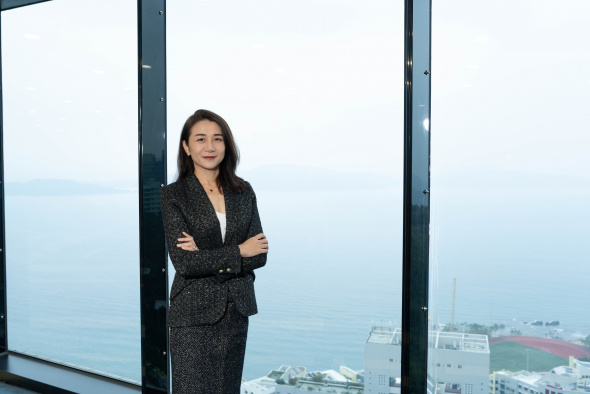
A large-scale international study led by Prof. Lu Mengqian, Professor of the Department of Civil and Environmental Engineering at HKUST, revealed that inter-city collaboration on emission reduction can improve overall sustainability performance by more than 10%.
A large-scale international study led by Prof. Lu Mengqian, Professor of the Department of Civil and Environmental Engineering at HKUST, revealed that inter-city collaboration on emission reduction can improve overall sustainability performance by more than 10%.  
A research team, led by Prof. Irene Lo Man-Chi (first right), Chair Professor of the Department of Civil and Environmental Engineering at HKUST and formed by HKUST Research Associate Dr. Zheng Zexiao (second left), PhD candidate Zhang Jin (center), postdoctoral fellow Dr. Jonathan J. Calvillo Solís (first left), and MPhil student Howard Y. M. Cheung (second right), has recently achieved a major breakthrough by discovering a novel oxidant-free electrocatalytic mechanism, opening up a new direction for water
A research team, led by Prof. Irene Lo Man-Chi (first right), Chair Professor of the Department of Civil and Environmental Engineering at HKUST and formed by HKUST Research Associate Dr. Zheng Zexiao (second left), PhD candidate Zhang Jin (center), postdoctoral fellow Dr. Jonathan J. Calvillo Solís (first left), and MPhil student Howard Y. M. Cheung (second right), has recently achieved a major breakthrough by discovering a novel oxidant-free electrocatalytic mechanism, opening up a new direction for water purification technologies. 
Enhances Pollutant Removal Efficiency and Potentially Doubles Economic Value Compared with Conventional Methods
Prof. Chen Hao (center), Assistant Professor of the Department of Computer Science and Engineering and the Department of Chemical and Biological Engineering and Director of the Collaborative Center for Medical and Engineering Innovation at HKUST, together with co-first authors Mr. HE Sunan (left) and Mr. NIE Yuxiang (right), both PhD students from the Department of Computer Science and Engineering, in collaboration with an international team, have developed the novel medical AI framework GSCo.
Prof. Chen Hao (center), Assistant Professor of the Department of Computer Science and Engineering and the Department of Chemical and Biological Engineering and Director of the Collaborative Center for Medical and Engineering Innovation at HKUST, together with co-first authors Mr. HE Sunan (left) and Mr. NIE Yuxiang (right), both PhD students from the Department of Computer Science and Engineering, in collaboration with an international team, have developed the novel medical AI framework GSCo. 
New GSCo Framework Significantly Improves Diagnostic Accuracy and Enables Low-Cost AI Model Development
Prof. Yang Yansong (left), Assistant Professor of the Department of Electronic and Computer Engineering of HKUST, and his PhD student Qian Fangsheng (right) have developed a novel chip architecture that enables the miniature acoustic devices inside smartphones to withstand over 12 times higher power loads while maintaining cooler and more stable operation.
Prof. Yang Yansong (left), Assistant Professor of the Department of Electronic and Computer Engineering of HKUST, and his PhD student Qian Fangsheng (right) have developed a novel chip architecture that enables the miniature acoustic devices inside smartphones to withstand over 12 times higher power loads while maintaining cooler and more stable operation. 
Prof. Gao Yang with a model of the first-generation Hong Kong Operation Robot, a novel multifunctional lunar surface robot being designed and developed by the HKUST-led InnoHK Hong Kong Space Robotics and Energy Centre (HKSREC) for the nation’s lunar exploration mission.
Prof. Gao Yang with a model of the first-generation Hong Kong Operation Robot, a novel multifunctional lunar surface robot being designed and developed by the HKUST-led InnoHK Hong Kong Space Robotics and Energy Centre (HKSREC) for the nation’s lunar exploration mission. 
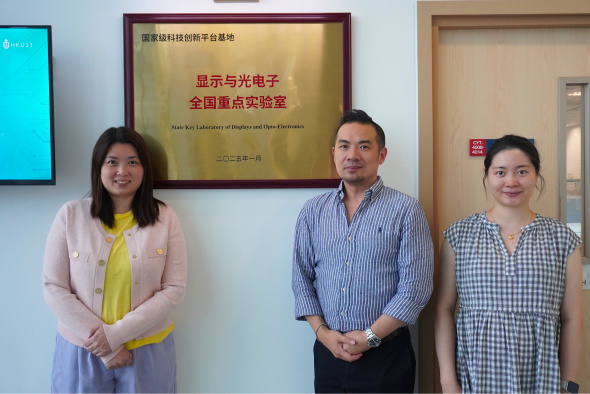
Prof. Lin Yen-Hung, Assistant Professor of the Department of Electronic and Computer Engineering at HKUST (center), Dr. Fion Yeung Sze-Yan, Senior Manager at the State Key Laboratory of Displays and Opto-Electronics (left), Dr. Li Fengzhu, Research Assistant Professor of the Department of Electronic and Computer Engineering at HKUST (right), and other research team members published “Interface-mediated crystallization enables PEDOT:PSS-free all-perovskite tandems with 29.1% efficiency and enhanced durabilit
Prof. Lin Yen-Hung, Assistant Professor of the Department of Electronic and Computer Engineering at HKUST (center), Dr. Fion Yeung Sze-Yan, Senior Manager at the State Key Laboratory of Displays and Opto-Electronics (left), Dr. Li Fengzhu, Research Assistant Professor of the Department of Electronic and Computer Engineering at HKUST (right), and other research team members published “Interface-mediated crystallization enables PEDOT:PSS-free all-perovskite tandems with 29.1% efficiency and enhanced durability” in Joule. 
Advancing the Commercialization of Perovskite Photovoltaic Technology