AI Literacy Beyond Tools: Preparing Lifelong Learners in the Age of AI
|
Prof. Kenneth LEUNG is Associate Professor of Engineering Education in the Department of Computer Science and Engineering at The Hong Kong University of Science and Technology (HKUST). His work focuses on artificial intelligence education, educational innovation, and technology-enhanced learning. He has led the development of AI-related curricula for students from diverse disciplines, including the Horizon AI Common Core course, and has actively promoted AI literacy through university teaching, STEM outreach programs, and MOOCs. He has collaborated closely with the HKUST Center for Education Innovation to develop 11 MOOCs that have attracted more than 250,000 learners worldwide. His teaching has been recognized by multiple university-wide awards, including the HKUST Common Core Teaching Excellence Award on three occasions. He is particularly interested in helping learners develop the curiosity, confidence, and adaptability needed to thrive in the age of AI. |


By Prof. Kenneth Leung
The Challenge: AI Changes Faster Than Curricula
Artificial intelligence is transforming engineering, industry, and society at an unprecedented pace. New AI models, platforms, and applications emerge almost monthly, continually reshaping how we learn, work, create, and solve problems. As educators, this rapid evolution presents an important challenge: how can we prepare students for a future when the technologies they will use after graduation may not yet exist today?
Many discussions about AI education focus on teaching students how to use the latest AI tools. While such skills are undoubtedly useful, they often have a limited lifespan. Interfaces change, platforms evolve, and new technologies quickly replace old ones. If AI education focuses solely on mastering specific tools, students may find that much of what they learned becomes outdated within a few years.
The key question therefore is not:
“How do we teach students to use today’s AI tools?”
but rather:
“How do we prepare students to learn tomorrow’s AI tools independently?”
AI Literacy Is More Than Tool Literacy
I believe AI literacy should extend beyond tool literacy. The ultimate goal is not simply to teach students how to use today’s AI systems, but to cultivate the curiosity, confidence, critical thinking, and adaptability needed to learn alongside future generations of AI technologies.
As engineering educators, we are preparing students for careers that may span four or five decades. During that time, AI technologies will undoubtedly undergo transformations that are difficult to predict today. Rather than attempting to teach every new tool that emerges, our responsibility is to help students develop the mindset and capabilities needed to navigate continual change.
In the age of AI, perhaps the most important skill is learning how to learn continuously.
A Lifelong Learning Perspective on AI Literacy
Over the years, I have had opportunities to engage learners across a wide spectrum of educational settings, including primary and secondary school outreach programs, university teaching, interdisciplinary Common Core courses, MOOCs, and lifelong learning initiatives.
These experiences have reinforced a simple observation: effective AI literacy is not developed through a single course or workshop. Instead, it emerges through a continuous learning journey that evolves alongside the learner.
This perspective has led me to view AI literacy as an educational ecosystem rather than a collection of isolated learning activities. At different stages of education, students require different forms of support, but the overarching objective remains the same: helping learners become increasingly confident, independent, and self-directed in their use of emerging technologies.
Four Principles for Building AI Literacy
Through my experiences across outreach, university teaching, and online learning, four educational principles have consistently guided my approach to AI literacy education.
1. Try-It-Before-We-Explain
Traditional education often begins with theory before application. However, when introducing AI to younger learners, I have found that curiosity is often a more effective starting point than technical explanations.
Students become excited when they can immediately interact with AI systems, create something meaningful, or observe unexpected outcomes. Once they have experienced the technology firsthand, discussions about the underlying concepts become far more engaging and meaningful.
The goal is not to memorize technical details but to help learners realize that AI technologies are accessible and that they are capable of exploring them independently.
2. What-You-See-Is-What-You-Get
As students progress, visible outcomes become powerful motivators for learning.
Modern AI tools allow learners to build applications, generate content, analyze data, and create prototypes much more rapidly than before. When students can immediately see the results of their ideas, they develop confidence in their ability to create and innovate.
This is particularly important for learners who may initially perceive programming, engineering, or AI as intimidating or inaccessible. Early successes often become the foundation for deeper exploration.
3. Prompt-Improve-and-Refine
One of the most valuable lessons students can learn about AI is that meaningful outcomes rarely emerge from a single interaction.
Effective use of AI often requires iterative refinement, critical evaluation, and continuous improvement. Students must learn to analyze outputs, identify limitations, refine their prompts, and improve their solutions.
In many ways, this process mirrors the engineering design cycle itself. AI therefore becomes not merely a tool for generating answers, but a platform for cultivating problem-solving, critical thinking, and creativity.
4. Spark-Explore-and-Continue
Perhaps the greatest challenge in education is ensuring that learning continues after formal instruction ends.
A successful workshop, course, or outreach activity should not represent the conclusion of a learning experience. Instead, it should serve as the beginning of a longer journey. When students leave a classroom with new questions to investigate, new ideas to explore, or new projects to build, meaningful learning continues long after the formal activity has ended.
The ultimate goal of AI literacy education is not simply engagement during a learning activity, but sustained curiosity and independent exploration afterward.
Building an AI Literacy Ecosystem
These four principles also highlight the need for educational institutions to think beyond individual courses.
AI literacy cannot be developed through isolated interventions alone. Students benefit most when learning opportunities are connected across different stages of education and supported by pathways for continued exploration.
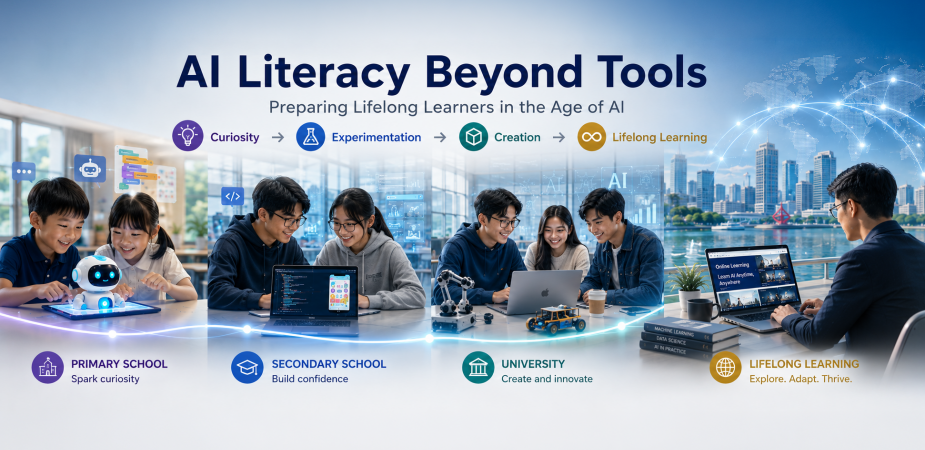
Primary school experiences can spark curiosity and accessibility. Secondary school programs can build confidence through experimentation and project creation. University education can support deeper interdisciplinary applications, critical thinking, and innovation. MOOCs and other lifelong learning opportunities can then provide mechanisms for continuous self-directed learning beyond formal classrooms.
When these components are connected, AI literacy becomes a sustainable ecosystem rather than a collection of disconnected activities. Learners are empowered not only to use AI technologies but also to adapt as those technologies evolve.
Beyond Today’s AI Tools
The success of AI education should not be measured by how many AI tools students can use today. Instead, it should be measured by whether they possess the curiosity to explore, the confidence to experiment, the judgement to evaluate, and the adaptability to learn the tools that have not yet been invented.
In the age of AI, our mission extends beyond teaching technology. It is about cultivating lifelong learners who can thrive alongside technology and continue learning throughout their professional and personal lives.
The technologies will change. The ability to learn, adapt, and innovate must endure.