


HKUST Researchers Unlock Why Arctic Ice Melt Paused
A research team led by The Hong Kong University of Science and Technology (HKUST) scholars has discovered a significant slowdown in Arctic sea ice melting since 2012, with the decrease rate of 11.3% per decade to an insignificant downward trend of only −0.4% per decade. This phenomenon is closely related to a shift in the North Atlantic Oscillation (NAO) pattern, from a negative phase to its positive phase, which traps cold air within the Arctic region. It is projected to peak between 2030 and 2040, after which the Arctic could enter a new phase of accelerated ice melt. Without reductions in greenhouse gas emissions, this may trigger severe climate and environmental crises within decades.
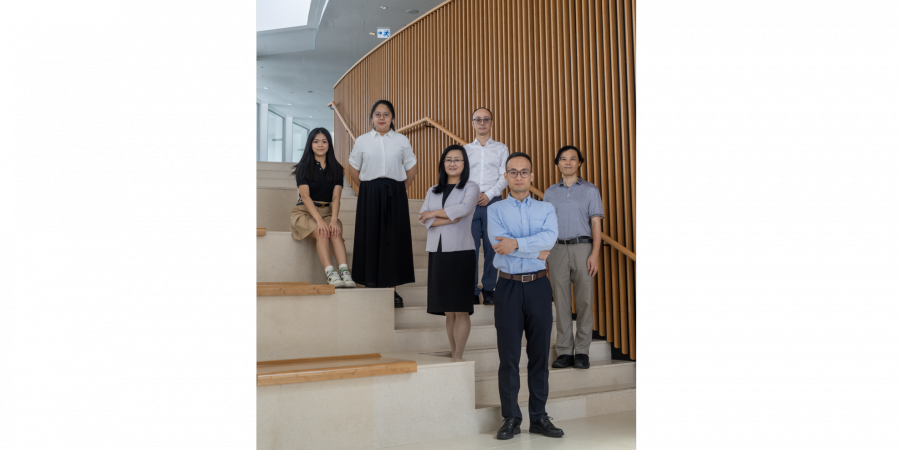
The groundbreaking study, titled “Recent slowing of Arctic sea ice melt tied to multidecadal NAO variability” has been published in Nature Communications. It is led by Prof. SU Hui, Chair Professor in the Department of Civil and Environmental Engineering and Global STEM Professor at HKUST, Prof. ZHAI Chengxing, Associate Professor from the Division of Emerging Interdisciplinary Areas at HKUST and Dr. WANG Cen, postdoctoral fellow of the Department of Civil and Environmental Engineering.
By analyzing multiple observational Arctic sea ice concentration (SIC) datasets, the research team uncovered striking trends. Since 1970, there is a sharp decrease in SIC with accelerated melt rates beginning in the 1990s and reaching a historic low in September 2012. Despite record global temperatures since 2014, the pace of Arctic ice loss slowed dramatically—from 11.3% per decade between 1996 and 2011 to just 0.4% per decade after 2012.
To decode this paradox, the team investigates the connection between internal atmospheric variability and multidecadal variability in Arctic sea ice. The team reveal a critical link between the NAO (changes in pressure between Azores and Iceland). The first author Dr. Wang Cen remarked, “Data show that between 1990 and the early 2010s, the NAO evolved towards its peak negative phase and summer anomalies of air temperature, water vapor and downwelling longwave radiation at surface changes from negative to positive, promoting rapid decline of Arctic sea ice. However, after 2012, the NAO transitioned to a positive phase, reversing these conditions. This led to an increasing tendency in sea ice extent on interdecadal scale that counteracts the long-term decline caused by persistent global warming.”
Prof. Su Hui who is an atmospheric science expert further elaborated, “The NAO focuses on the North Atlantic region, from North Africa and the Mediterranean to Northern Europe. It is inseparable from the Arctic Oscillation (AO), which governs high-latitude westerly winds around the Arctic. When the NAO is in its positive phase, stronger westerlies over the North Atlantic intensify storm activity. Simultaneously, the AO enters its positive phase, lowering average Arctic pressure, cooling the air, and trapping frigid polar air within the Arctic via powerful westerlies.”
Prof. Zhai Chengxing warned, “Our projections indicate the NAO’s positive phase is likely to extend until roughly 2030–2040, followed by a phase of accelerated Arctic sea ice decline when the NAO passes the peak positive phase. In the absence of greenhouse gas emission reduction, we may encounter a sequence of climate and environmental crises triggered by a sharp reduction in Arctic sea ice after approximately a decade or so.”
The study also involves postdoctoral fellow Dr. YU Shiwei and PhD students MO Huisi and WANG Yanjia from the Department of Civil and Environmental Engineering, as well as collaborators from the School of Earth and Space Sciences at the University of Science and Technology of China.
