Research

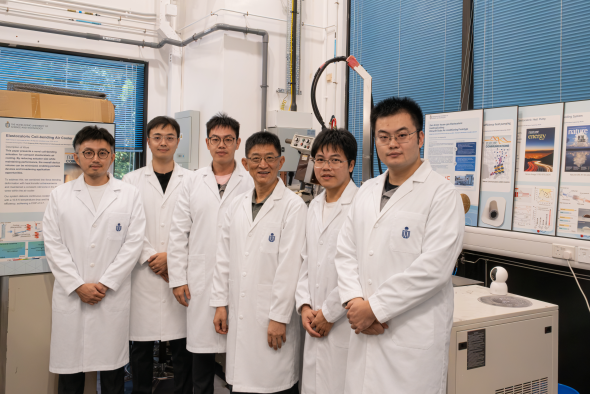
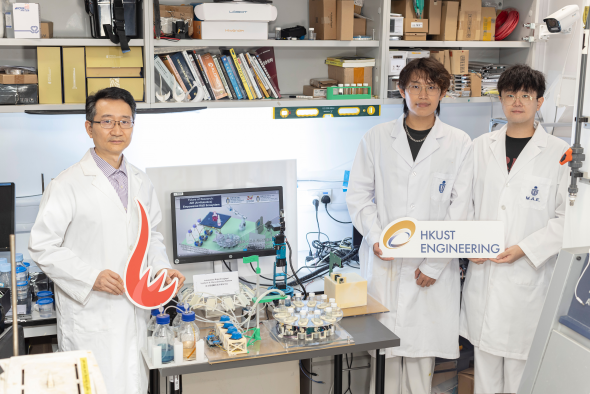
An HKUST research team led by Prof. Hu Wenqi (left third) and Prof. Xu Qin (third right) develops soft composites with non-reciprocal responses through shear-jamming transitions.
An HKUST research team led by Prof. Hu Wenqi (left third) and Prof. Xu Qin (third right) develops soft composites with non-reciprocal responses through shear-jamming transitions. 
Prof. Guo Yike, Provost and Chair Professor of the Department of Computer Science and Engineering and the Department of Electronic and Computer Engineering at HKUST, has been elected as an International Member of the Chinese Academy of Engineering. Prof. Guo stated, “I am deeply honored to be elected as an International Member of the Chinese Academy of Engineering and sincerely thanks for this recognition.”
Prof. Guo Yike, Provost and Chair Professor of the Department of Computer Science and Engineering and the Department of Electronic and Computer Engineering at HKUST, has been elected as an International Member of the Chinese Academy of Engineering. Prof. Guo stated, “I am deeply honored to be elected as an International Member of the Chinese Academy of Engineering and sincerely thanks for this recognition.” 
Prof. Yang Hai (second left), Prof. Shao Minhua (first left) and Prof. Chen Hao (second right) were presented the SENG Research Excellence Award 2024-25 by Prof. Hong K. Lo (first right), Dean of Engineering.
Prof. Yang Hai (second left), Prof. Shao Minhua (first left) and Prof. Chen Hao (second right) were presented the SENG Research Excellence Award 2024-25 by Prof. Hong K. Lo (first right), Dean of Engineering. 
Recognizing Outstanding Research Impact and Contributions
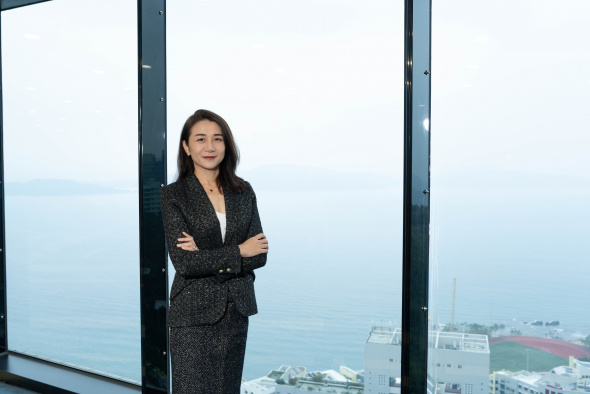
Witnessed by HKUST Provost Prof. Yike Guo (second left) and Vice Chair of Strategic Executive Committee and Chief Executive Officer of JD.com Ms. Sandy Xu (center), the agreement was signed by HKUST Vice-President for Research and Development Prof. Tim Cheng (first left) and JD.com representatives (first and second right), for the establishment of “HKUST – JD.com Joint Laboratory”.
Witnessed by HKUST Provost Prof. Yike Guo (second left) and Vice Chair of Strategic Executive Committee and Chief Executive Officer of JD.com Ms. Sandy Xu (center), the agreement was signed by HKUST Vice-President for Research and Development Prof. Tim Cheng (first left) and JD.com representatives (first and second right), for the establishment of “HKUST – JD.com Joint Laboratory”. 
Addressing Critical Technological Challenges in Smart Supply Chains
A research team led by Prof. Qu Jianan, Professor of the Department of Electronic and Computer Engineering, School of Engineering, HKUST, has introduced a groundbreaking technique that can capture high-resolution images of the awake mice brain in a near non-invasive manner. The advancement promises deeper insights into human brain function in both healthy and diseased conditions.
A research team led by Prof. Qu Jianan, Professor of the Department of Electronic and Computer Engineering, School of Engineering, HKUST, has introduced a groundbreaking technique that can capture high-resolution images of the awake mice brain in a near non-invasive manner. The advancement promises deeper insights into human brain function in both healthy and diseased conditions. 
Group photo of the research team: Prof. Abhishek K. Srivastava (second right), corresponding author of the study; Liao Zebing (center), PhD student and first author of the study; as well as co-authors including postdoctoral fellow Dr. Maksym Prodanov (first right), PhD students Mallem Kumar (second left) and Song Jianxin (first left). Mr Liao holds a red emitting QR-LED sample.
Group photo of the research team: Prof. Abhishek K. Srivastava (second right), corresponding author of the study; Liao Zebing (center), PhD student and first author of the study; as well as co-authors including postdoctoral fellow Dr. Maksym Prodanov (first right), PhD students Mallem Kumar (second left) and Song Jianxin (first left). Mr Liao holds a red emitting QR-LED sample. 
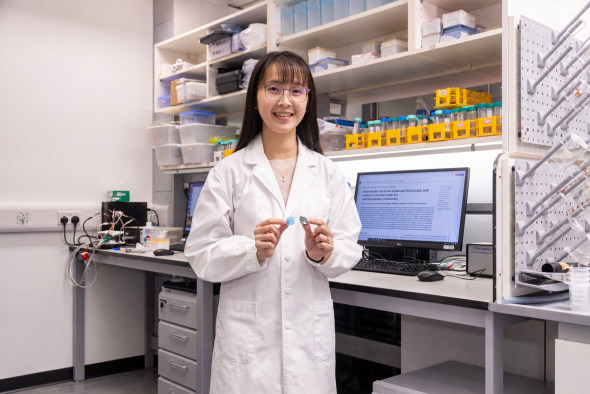
Prof. Sherry Chen Xian (left), The Hong Kong University of Science and Technology, and Dr. Zhang Chenbo (right), Tongji University, developed FerroAI, a deep learning model that can produce phase diagrams for ferroelectric materials in just 20 seconds. Their findings represent a significant advancement in AI-driven ferroelectric materials research.
Prof. Sherry Chen Xian (left), The Hong Kong University of Science and Technology, and Dr. Zhang Chenbo (right), Tongji University, developed FerroAI, a deep learning model that can produce phase diagrams for ferroelectric materials in just 20 seconds. Their findings represent a significant advancement in AI-driven ferroelectric materials research. 
Artificial Intelligence Empowers Ferroelectric Materials Research
(圖示一)在多模態指令生成任務中,DreamOmni2能基於圖片中的實體進行圖像生成,例如提取圖一的畫作掛在臥室牆上,將圖二盤子的材質套用在圖三的水杯,並將水杯放置在桌子上,以生成符合用家要求的新圖像。
(圖示一)在多模態指令生成任務中,DreamOmni2能基於圖片中的實體進行圖像生成,例如提取圖一的畫作掛在臥室牆上,將圖二盤子的材質套用在圖三的水杯,並將水杯放置在桌子上,以生成符合用家要求的新圖像。 
A photo of Prof. Chen Hao (right), Director of Collaboration Center for Medical and Engineering Innovation, and Assistant Professor of the Department of Computer Science and Engineering and Department of Chemical and Biological Engineering, and Prof. Liang Li (left), Director of Department of Pathology at Nanfang Hospital and Professor of School of Basic Medical Sciences at Southern Medical University.
A photo of Prof. Chen Hao (right), Director of Collaboration Center for Medical and Engineering Innovation, and Assistant Professor of the Department of Computer Science and Engineering and Department of Chemical and Biological Engineering, and Prof. Liang Li (left), Director of Department of Pathology at Nanfang Hospital and Professor of School of Basic Medical Sciences at Southern Medical University. 
Prof. Dan Tsang’s research team published a research paper titled “Reducing environmental burden of electroplating wastewater treatment by ternary cooperation of zero-valence iron, manganese, and graphitic biochar” in Communications Materials, a journal from Nature Portfolio, in March 2025. Co-authors include Dr. Xu Zibo (first author), Dr. Zhang Yuying, as well as collaborators from Imperial College London (UK), Shanghai Jiao Tong University (China), University of Wuppertal (Germany), University of Califor
Prof. Dan Tsang’s research team published a research paper titled “Reducing environmental burden of electroplating wastewater treatment by ternary cooperation of zero-valence iron, manganese, and graphitic biochar” in Communications Materials, a journal from Nature Portfolio, in March 2025. Co-authors include Dr. Xu Zibo (first author), Dr. Zhang Yuying, as well as collaborators from Imperial College London (UK), Shanghai Jiao Tong University (China), University of Wuppertal (Germany), University of California, Davis (US), and Korea University.