
HKUST Engineering Develops Novel Calcium-Ion Battery Technology Enhancing Energy Storage Efficiency and Sustainability
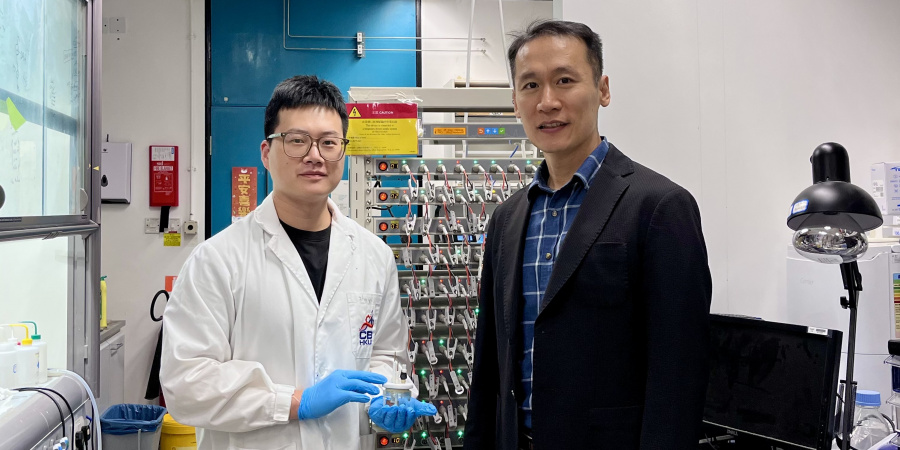
Researchers at The Hong Kong University of Science and Technology (HKUST) have achieved a breakthrough in calcium-ion battery (CIB) technology, which could transform energy storage solutions in everyday life. Utilizing quasi-solid-state electrolytes (QSSEs), these innovative CIBs promise to enhance the efficiency and sustainability of energy storage, impacting a wide range of applications from renewable energy systems to electric vehicles. The findings are published in the international journal Advanced Science titled “High-Performance Quasi-Solid-State Calcium-Ion Batteries from Redox-Active Covalent Organic Framework Electrolytes”.
The urgency for sustainable energy storage solutions is growing critical worldwide. As the world accelerates its shift to green energy, the demand for efficient and stable battery systems has never been more pressing. Today’s mainstream lithium-ion batteries (LIBs) face challenges due to resource scarcity and near-limited energy density, making the exploration of alternatives like CIBs essential for a sustainable future.
CIBs hold great promise due to their electrochemical window comparable to that of LIBs and their abundance on Earth. However, they have struggles, particularly in achieving efficient cation transport and maintaining stable cycling performance. These obstacles currently limit the competitiveness of CIBs against commercially available LIBs.
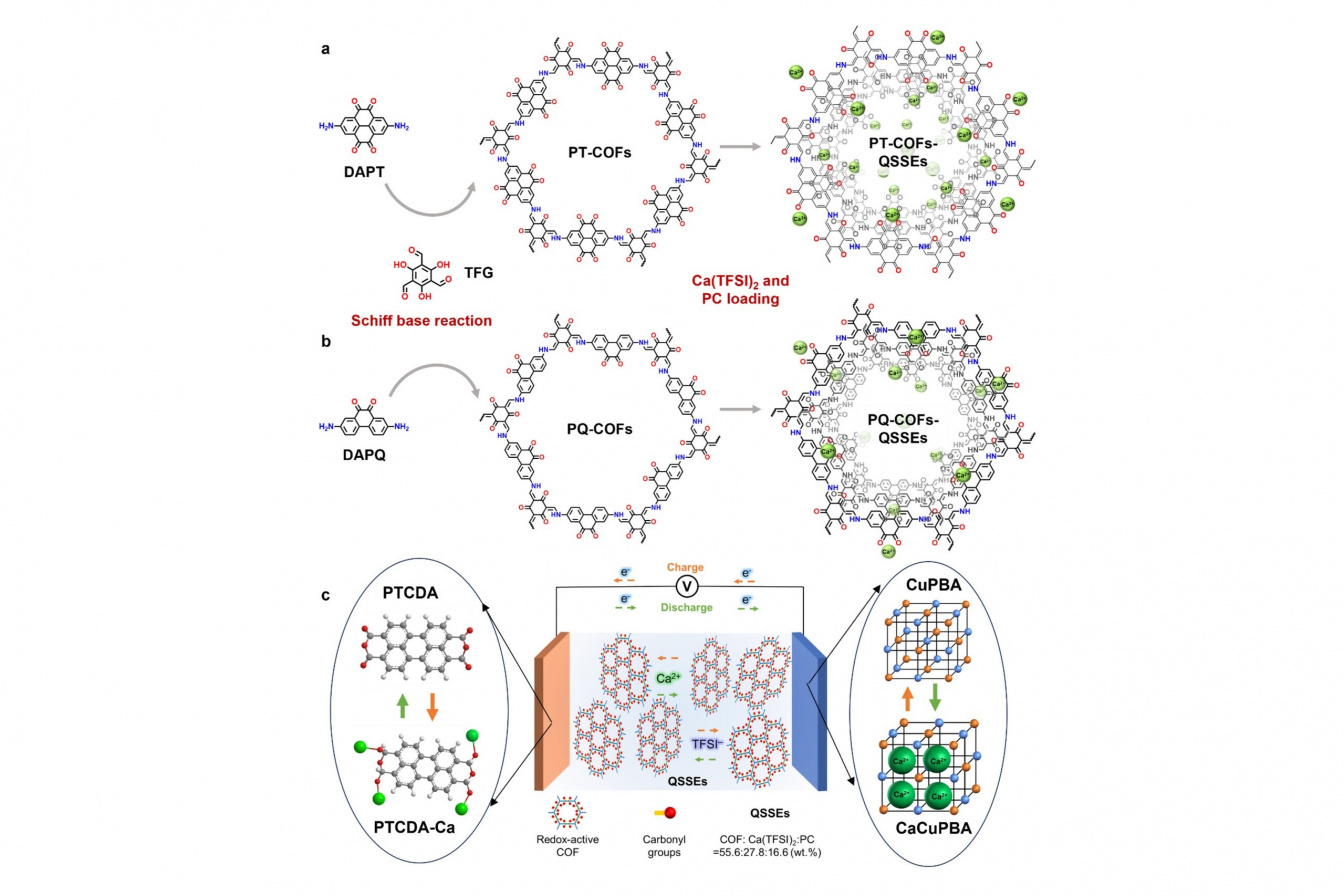
To overcome these challenges, the research team led by Prof. Yoonseob KIM, Associate Professor of the Department of Chemical and Biological Engineering at HKUST, has developed redox covalent organic frameworks to serve as QSSEs. These carbonyl-rich QSSEs demonstrated remarkable ionic conductivity (0.46 mS cm–1) and Ca2+ transport capability (>0.53) at room temperature. Combining experimental and simulation studies, the team revealed that Ca2+ rapidly transports along the aligned carbonyl groups within the ordered COFs pores.
This innovative approach led to the creation of a full calcium-ion cell that exhibited a reversible specific capacity of 155.9 mAh g–1 at 0.15 A g–1 and maintained over 74.6% capacity retention at 1 A g–1 after 1,000 cycles, showcasing the potential of redox COFs to advance CIB technology.
Prof. Kim said, “Our research highlights the transformative potential of calcium-ion batteries as a sustainable alternative to lithium-ion technology. By leveraging the unique properties of redox covalent organic frameworks, we have taken a significant step towards realizing high-performance energy storage solutions that can meet the demands of a greener future.”
This study was a collaboration between researchers at HKUST and Shanghai Jiao Tong University.
About The Hong Kong University of Science and Technology
The Hong Kong University of Science and Technology (HKUST) (https://hkust.edu.hk/) is a world-class university known for its innovative education, research excellence, and impactful knowledge transfer. With a holistic and interdisciplinary pedagogy approach, HKUST was ranked 6th in the QS Asia University Rankings 2026, 3rd in the Times Higher Education’s Young University Rankings 2024, and 19th globally and 1st in Hong Kong in the Times Higher Education’s Impact Rankings 2025. Thirteen HKUST subjects were ranked among the world’s top 50 in the QS World University Rankings by Subject 2025, with “Data Science and Artificial Intelligence” coming in 17th worldwide and first in Hong Kong. Our graduates are highly competitive, consistently ranking among the world’s top 30 most sought-after employees. In terms of research and entrepreneurship, over 80% of our work was rated “internationally excellent” or “world leading” in the Research Assessment Exercise 2020 of the Hong Kong’s University Grants Committee. As of July 2025, HKUST members have founded over 1,900 active start-ups, including 10 Unicorns and 17 exits (IPO or M&A).
(This news was originally published by the HKUST Global Engagement and Communications Office here.)