

HKUST Researchers Pioneer Pathway to Mechanical Intelligence by Breaking Symmetry in Soft Composite Materials
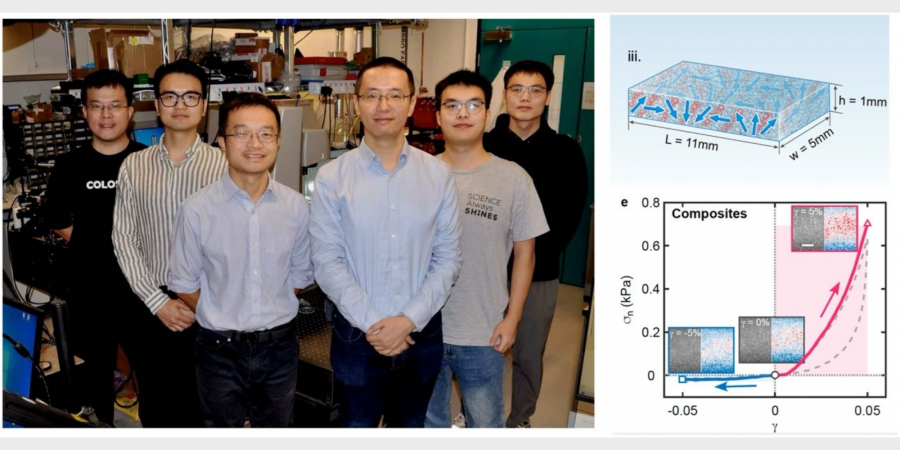
A research team, led by Prof. HU Wenqi from the Department of Mechanical and Aerospace Engineering (MAE) and Prof. XU Qin from the Department of Physics (PHYS) at The Hong Kong University of Science and Technology (HKUST), has developed soft composite systems with highly programmable, asymmetric mechanical responses. By integrating “shear-jamming transitions” into compliant polymeric solids, this innovative work enhances key material functionalities essential for engineering mechano-intelligent systems—a major step toward the development of next-generation smart materials and devices.
In engineering fields such as soft robotics, synthetic tissues, and flexible electronics, materials that exhibit direction-dependent responses to external stimuli are crucial for realizing intelligent functions. Conventional methods to achieve such asymmetry, however, often rely on the structural nonlinearities of discrete metamaterials, which are inherently sensitive to defects and fractures. In contrast, the new design paradigm introduced by HKUST researchers leverages shear-jammed soft composites, offering a versatile and robust alternative with programmable and defect-tolerant performance.
The scientific and engineering impacts of this approach are summarized below:
• Multi-Directional Control: The engineered soft composites exhibit non-reciprocal behaviors in both shear and normal directions, simultaneously enabling asymmetric shape memory properties.
• Programmable and Tough: Unlike brittle, rigid metamaterials, these soft composites are highly programmable and remarkably fracture-resistant. Their mechanical properties can be tailored across multiple scales through the shear-jamming phase transition, allowing for custom-designed performance in diverse applications.
• Active and Intelligent Materials: By integrating these shear-jammed structures with spatially-modulated magnetic profiles, the team developed “active soft solids” capable of directional motion. These materials function as a bio-inspired soft robots that can navigate confined environments and enable selective flow control as smart valves in microfluidic systems.
From a scientific perspective, the study bridges the fields of granular physics and polymer science, creating a new class of non-reciprocal soft materials. From an engineering standpoint, it establishes a powerful design strategy for a wide range of soft composites with directionally sensitive and adaptive responses. This approach not only represents a critical pathway toward achieving mechanical intelligence, but also opens the door to smart, energy-efficient materials capable of interacting intelligently with their environments.
This interdisciplinary study, conducted by HKUST researchers from the Departments of MAE and PHYS, was recently published in Nature Materials. XU Chang, a PhD student from the Department of PHYS, is the first author of this paper. The research was supported by the Hong Kong Research Grants Council and the HKUST Marine Robotics and Blue Economy Technology Grant.
About The Hong Kong University of Science and Technology
The Hong Kong University of Science and Technology (HKUST) (https://hkust.edu.hk/) is a world-class university known for its innovative education, research excellence, and impactful knowledge transfer. With a holistic and interdisciplinary pedagogy approach, HKUST was ranked 6th in the QS Asia University Rankings 2026, 3rd in the Times Higher Education’s Young University Rankings 2024, and 19th globally and 1st in Hong Kong in the Times Higher Education’s Impact Rankings 2025. Thirteen HKUST subjects were ranked among the world’s top 50 in the QS World University Rankings by Subject 2025, with “Data Science and Artificial Intelligence” coming in 17th worldwide and first in Hong Kong. Our graduates are highly competitive, consistently ranking among the world’s top 30 most sought-after employees. In terms of research and entrepreneurship, over 80% of our work was rated “internationally excellent” or “world leading” in the Research Assessment Exercise 2020 of the Hong Kong’s University Grants Committee. As of July 2025, HKUST members have founded over 1,900 active start-ups, including 10 Unicorns and 17 exits (IPO or M&A).
(This news was originally published by the HKUST Global Engagement and Communications Office here.)