SENG Teaching Excellence Appreciation Award 2025-26
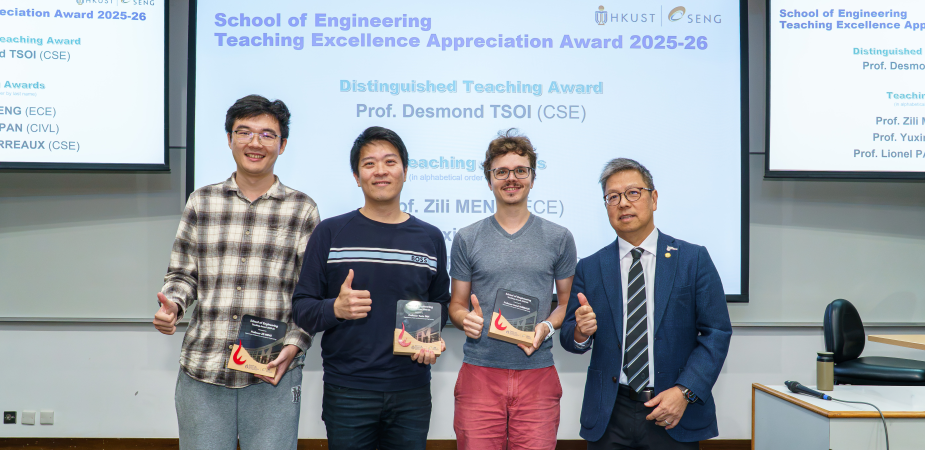
Four faculty members were honored in the School of Engineering (SENG) Teaching Excellence Appreciation Award 2025-26. The award recognizes faculty members who demonstrate continuous excellence in undergraduate teaching, foster students’ interest in the subject, promote students’ learning, develop innovative and effective teaching methodologies, and more. Among the awardees this year, one was selected for the Distinguished Teaching Award.
Recipient of Distinguished Teaching Award:
- Prof. Desmond TSOI, Associate Professor of Engineering Education, Department of Computer Science and Engineering; Associate Director, Center for Engineering Education Innovation
Recipients of Teaching Awards (in alphabetical order of last names):
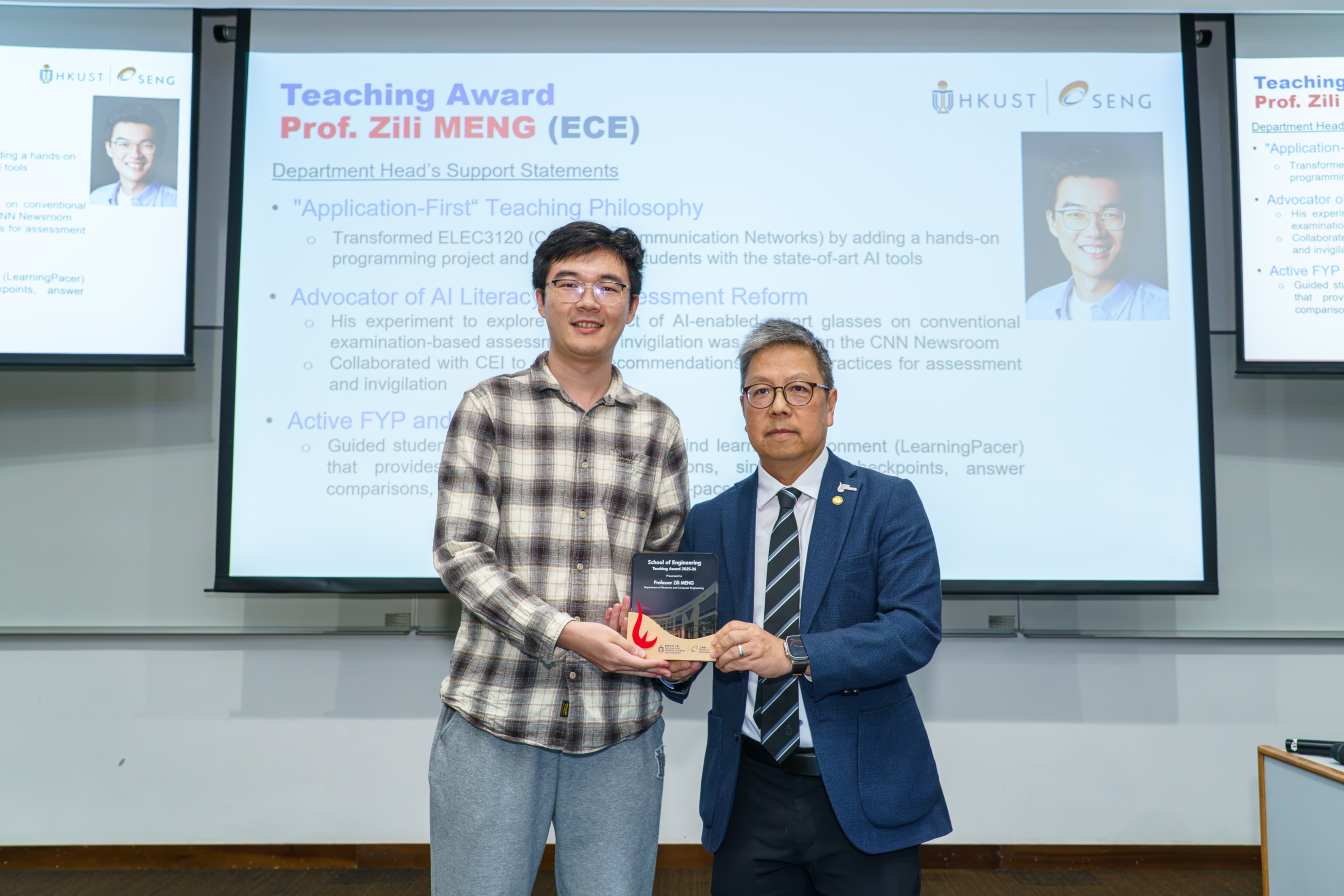
- Prof. MENG Zili, Assistant Professor, Department of Electronic and Computer Engineering
- Prof. PAN Yuxin, Assistant Professor, Department of Civil and Environmental Engineering
- Prof. Lionel PARREAUX, Assistant Professor, Department of Computer Science and Engineering
Since joining HKUST in 2016, Prof. Desmond Tsoi has been the CSE Department’s highest scorer on the Student Feedback Questionnaire in 18 out of 21 semesters and ranked a close second in the remaining three, an extraordinary record of achievement that is rarely matched. His excellence is particularly evident in COMP 1023 Introduction to Python Programming, a foundational course he designed for the BEng in Artificial Intelligence program and served more than 1,700 students in its first year. Highlighting the lasting impact of his curricular innovations, evidence from learning analytics shows that students who complete COMP 1023 perform significantly better in subsequent programming course. A pioneer in innovative learning and assessment technologies, he has led or co-developed platforms including ZINC 2.0, OO-CoBE, and several AI-enhanced educational tools that have become integral to the department’s teaching infrastructure. Over the past three years, he has represented SENG and the department in numerous talks and engagement activities, inspiring prospective students and promoting emerging technologies.
Prof. Meng Zili firmly believes that “students should harness powerful tools without surrendering their judgment” in the AI era. His course ELEC 3120 Computer Communication Networks seamlessly integrates cutting-edge computer and IT tools into students’ experiential learning. His “application-first” teaching philosophy helps students to gain deep understanding of abstract computer network concepts through a carefully designed and systematically assessed hands-on programming project. To empower students with state-of-the-art AI tools, he constantly updated for his course the software development environment from ChatGPT to Copilot, coding agents, and now natural-language workflows. He engages his students who finished ELEC 3120 to be co-designers of a one-of-a-kind online learning environment (LearningPacer) that provides course-grounded explanations, simulations, checkpoints, answer comparisons, and mock exams for later students’ self-paced learning. He actively examines how AI can automate assessment, and is the first in the department to adopt assessment platform Gradescope and to study systematically the impact of smart glasses on conventional exam-based assessment and invigilation.
Prof. Pan Yuxin helps students connect structural theory with the decision, testing and professional responsibility that define civil engineering. In CIVL 2120 Mechanics of Materials and CIVL 4320 Structural Steel Design, he uses demonstrations, student participation and design questions to make structural behavior and engineering assumptions discussable rathe than treating calculations as ends in themselves. In CIVL 4100M Design of Timber Structures, his design-test-reflect-redesign sequence enables students to bridge the gap between a calculated answer and a buildable, tested structure. This approach offers a practical model that other design-led civil engineering courses could adapt. In student competition coaching, he led students to win the championship in IDEERS 2025 (Introducing and Demonstrating Earthquake Engineering Research in Schools), among 49 international teams.
Prof. Lionel PARREAUX’s courses, notably COMP 4121 Modern Compiler Construction and COMP 3031 Principles of Programming Languages, have received exceptionally positive evaluations from students. He developed COMP 4121, which is the University’s first course on modern compiler construction, and redesigned COMP 3031 by modernizing its content and strengthening its relevance to contemporary software development. Such enhancements have enriched the curriculum and provided students with a stronger integration of theoretical foundations and practical applications. He has supervised numerous PhD, MPhil and undergraduate students, many of whom have achieved notable academic distinctions and research successes.