Electronic and Computer Engineering

Prof. Shen Yajing (third right), Professor of the Department of Electronic and Computer Engineering, and members of his research team, including Dr. Tang Yifeng (third left), Yin Tianci (second right), Dr. Li Gen (second left), Ling Zhengrong (first right), and Wang Hexiang (first left), showcase the Embodied Sensorimotor Robotic Arm (EmArm) developed by the team.
Prof. Shen Yajing (third right), Professor of the Department of Electronic and Computer Engineering, and members of his research team, including Dr. Tang Yifeng (third left), Yin Tianci (second right), Dr. Li Gen (second left), Ling Zhengrong (first right), and Wang Hexiang (first left), showcase the Embodied Sensorimotor Robotic Arm (EmArm) developed by the team. 
Simulating Human Tactile Perception to Advance Embodied AI
Strengthening Research Collaboration between France and Hong Kong
HKUST proposes the “Reasoning-Empowered Task-Oriented Communication” framework, equipping AI agents with autonomous logical reasoning capabilities to determine what information to share, when to communicate, and why information exchange is necessary. The research team includes Prof. Khaled B. Letaief (front row, center), Prof. Zhang Jun (front row, left), Prof. Song Shenghui (front row, right), Dr. Wang Zixin (back row, right), Xie Songjie (back row, first left) and Li Hongru (back row, second left).
HKUST proposes the “Reasoning-Empowered Task-Oriented Communication” framework, equipping AI agents with autonomous logical reasoning capabilities to determine what information to share, when to communicate, and why information exchange is necessary. The research team includes Prof. Khaled B. Letaief (front row, center), Prof. Zhang Jun (front row, left), Prof. Song Shenghui (front row, right), Dr. Wang Zixin (back row, right), Xie Songjie (back row, first left) and Li Hongru (back row, second left). 
Reasoning-Empowered Communication Framework Enables AI Agents to Collaborate at Scale
Mr. Steven Ying (second left), Director of the Foundation for Amazing Potentials; Liao Zebing (center), 2025/26 recipient of the Ying Family PhD Research Award and PhD student of the Department of Electronic and Computer Engineering (ECE); Prof. Shao Minhua (second right), Director of the HKUST Energy Institute; Prof. Andrew Poon (first left), Head and Professor of the ECE Department; and Prof. Abhishek Srivastava (first right), Associate Professor of the ECE Department and Zebing’s supervisor.
Mr. Steven Ying (second left), Director of the Foundation for Amazing Potentials; Liao Zebing (center), 2025/26 recipient of the Ying Family PhD Research Award and PhD student of the Department of Electronic and Computer Engineering (ECE); Prof. Shao Minhua (second right), Director of the HKUST Energy Institute; Prof. Andrew Poon (first left), Head and Professor of the ECE Department; and Prof. Abhishek Srivastava (first right), Associate Professor of the ECE Department and Zebing’s supervisor. 
Recognizing Excellence in Sustainability and Green Tech Research
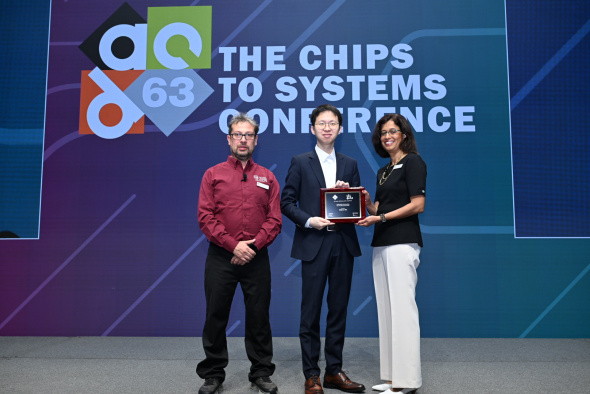
Prof. Xie Zhiyao (center) received the ACM SIGDA Outstanding New Faculty Award 2026 at the Design Automation Conference 2026. He is the first recipient from a Hong Kong tertiary institution to receive this highly competitive award since it was first presented in 2000.
Prof. Xie Zhiyao (center) received the ACM SIGDA Outstanding New Faculty Award 2026 at the Design Automation Conference 2026. He is the first recipient from a Hong Kong tertiary institution to receive this highly competitive award since it was first presented in 2000. 
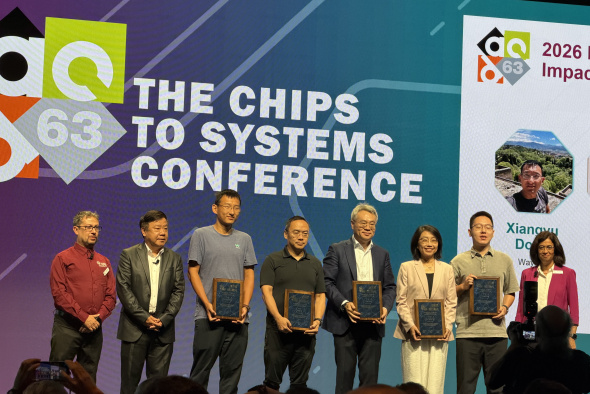
Prof. Xie Yuan (fourth left) and his former PhD students and collaborators received the prestigious 2026 ACM/IEEE A. Richard Newton Technical Impact Award in Electronic Design Automation at the 63rd Design Automation Conference, held in Long Beach, California, in July 2026.
Prof. Xie Yuan (fourth left) and his former PhD students and collaborators received the prestigious 2026 ACM/IEEE A. Richard Newton Technical Impact Award in Electronic Design Automation at the 63rd Design Automation Conference, held in Long Beach, California, in July 2026. 
Prof. Yang Yansong (left), Assistant Professor of the Department of Electronic and Computer Engineering of HKUST, and his PhD student Qian Fangsheng (right) have developed a novel chip architecture that enables the miniature acoustic devices inside smartphones to withstand over 12 times higher power loads while maintaining cooler and more stable operation.
Prof. Yang Yansong (left), Assistant Professor of the Department of Electronic and Computer Engineering of HKUST, and his PhD student Qian Fangsheng (right) have developed a novel chip architecture that enables the miniature acoustic devices inside smartphones to withstand over 12 times higher power loads while maintaining cooler and more stable operation. 
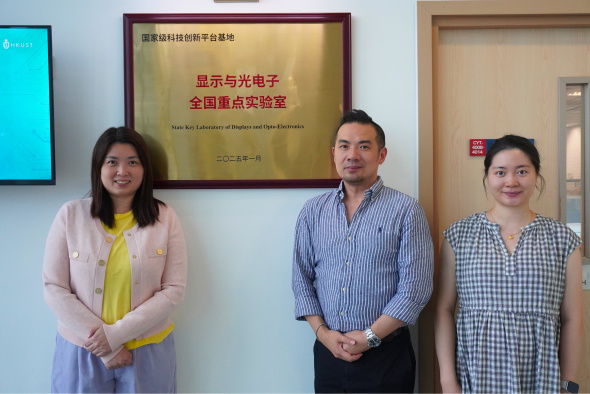
Prof. Lin Yen-Hung, Assistant Professor of the Department of Electronic and Computer Engineering at HKUST (center), Dr. Fion Yeung Sze-Yan, Senior Manager at the State Key Laboratory of Displays and Opto-Electronics (left), Dr. Li Fengzhu, Research Assistant Professor of the Department of Electronic and Computer Engineering at HKUST (right), and other research team members published “Interface-mediated crystallization enables PEDOT:PSS-free all-perovskite tandems with 29.1% efficiency and enhanced durabilit
Prof. Lin Yen-Hung, Assistant Professor of the Department of Electronic and Computer Engineering at HKUST (center), Dr. Fion Yeung Sze-Yan, Senior Manager at the State Key Laboratory of Displays and Opto-Electronics (left), Dr. Li Fengzhu, Research Assistant Professor of the Department of Electronic and Computer Engineering at HKUST (right), and other research team members published “Interface-mediated crystallization enables PEDOT:PSS-free all-perovskite tandems with 29.1% efficiency and enhanced durability” in Joule. 
Advancing the Commercialization of Perovskite Photovoltaic Technology
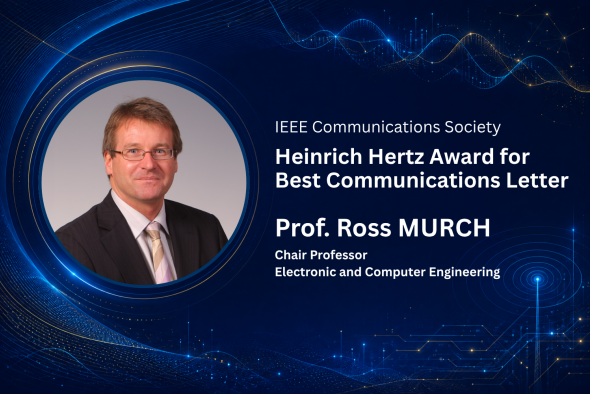
Breaking New Ground in Communications Engineering