
Prof. YANG Yansong Awarded Funding in France-Hong Kong ANR/RGC Joint Research Scheme 2026/27
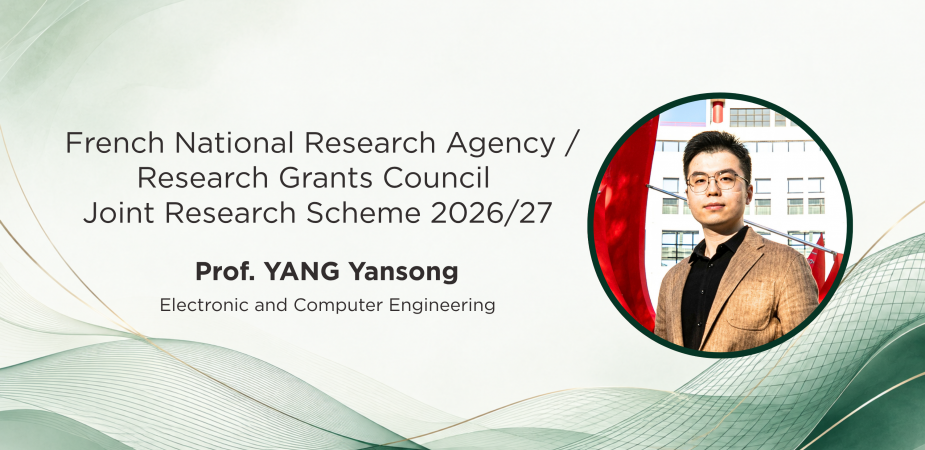

A project led by Prof. YANG Yansong, Assistant Professor of the Department of Electronic and Computer Engineering, was awarded funding under the French National Research Agency (ANR) / Research Grants Council (RGC) Joint Research Scheme 2026/27.
Prof. Yang will collaborate with Prof. Fabrice STHAL from SUPMICROTECH - Ecole Nationale Supérieure de Mécanique et des Microtechniques to work on their project titled “Lithium Niobate-on-Sealed-Cavity (LNoSC) Platform for Next-Generation Acoustic Microsystems”. The project will be funded for four years, from 2027 to 2031.
Run by the French National Research Agency (Agence Nationale de la Recherche) and the Research Grants Council of Hong Kong, the Joint Research Scheme aims to strengthen collaboration between the French and Hong Kong research communities. A total of six projects are selected this year.
The central objective of Prof. Yang’s project is to redefine lithium niobate integration in acoustic microelectronics by establishing a Lithium Niobate on Sealed Cavity platform based on direct CVD growth on silicon substrates engineered through silicon migration. The project pursues two closely connected scientific aims. First, to transform lithium niobate from a material, constrained by heterogeneous thin-film transfer, into a structurally programmable platform integrated with wafer-level sealed vacuum cavities. Second, to establish physical understanding of acoustic dissipation and phase noise mechanisms in lithium niobate acoustic microsystems.
Lithium niobate is one of the most versatile materials in modern information technology. In acoustics, its strong piezoelectric coupling makes it a key material for radio-frequency filters in smartphones and base stations and for ultrasonic sensing and imaging; in optics, its strong electro-optic and nonlinear optical effects underpin high-speed modulators for fiber-optic communications and emerging integrated and quantum photonic chips. However, high-quality lithium niobate thin films are currently made mainly by heterogeneous thin-film transfer, in which a bulk crystal wafer is bonded onto a carrier wafer and then thinned by ion slicing or polishing. This approach requires ultra-flat bonding surfaces, introduces stress and defects at the bonding interface, limits control of film thickness and uniformity across the wafer, and is difficult to combine with suspended or cavity-based structures, which restricts the development of devices toward more complex structures and 3D integration. Chemical vapor deposition (CVD), adopted in this project, can overcome these limitations by growing lithium niobate directly on the target substrate, with no bonding step, precise thickness control, and compatibility with engineered structures such as sealed vacuum cavities. If high-quality CVD lithium niobate can be achieved at wafer scale, lithium niobate thin-film devices could break free from the single device structure imposed by bonding processes and make more efficient use of the multiphysics properties of lithium niobate, paving the way for compact, low-loss filters for higher-frequency 6G and satellite communications, ultra-stable, low-noise frequency sources, higher-resolution ultrasound imaging, and more highly integrated photonic chips.
Prof. Yang joined HKUST in early 2022. Prior to that, he was a postdoc research associate at the University of Illinois at Urbana-Champaign (UIUC), where he received his PhD and MS in Electrical Engineering in 2019 and 2017 respectively. He gained his BS degree from Huazhong University of Science and Technology in 2014. His research encompasses design methodologies, nano- and microscale fabrication techniques, as well as AI design and AI manufacturing of next-generation ultrasonic and radio-frequency microelectromechanical systems (ultrasonic/RF MEMS).