
















HKUST ENGINEERING

Title
Research
Description
How we turn bold ideas into tangible results
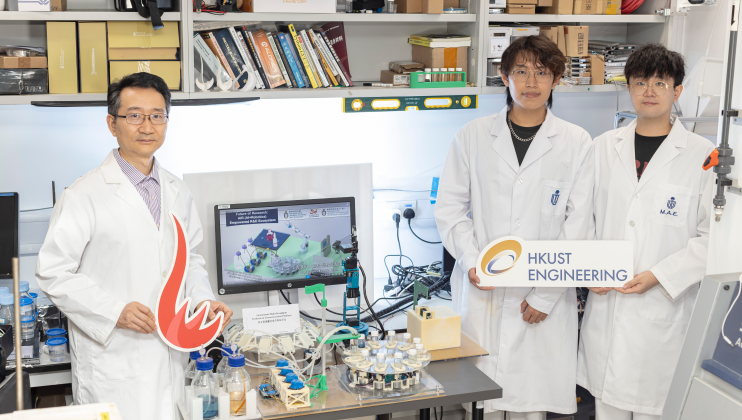
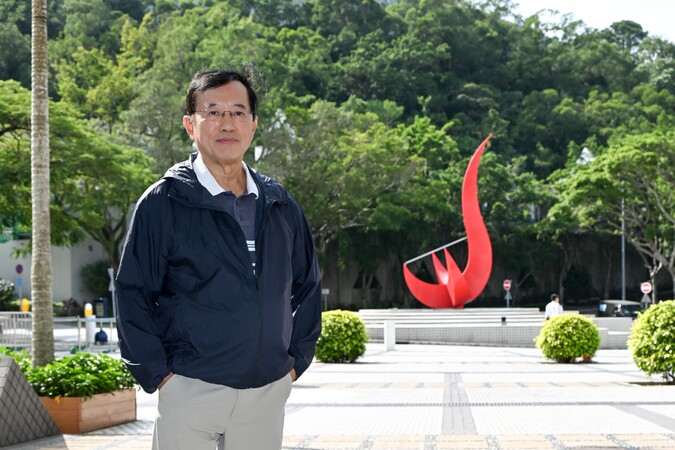
A research team, led by Prof. Irene Lo Man-Chi (first right), Chair Professor of the Department of Civil and Environmental Engineering at HKUST and formed by HKUST Research Associate Dr. Zheng Zexiao (second left), PhD candidate Zhang Jin (center), postdoctoral fellow Dr. Jonathan J. Calvillo Solís (first left), and MPhil student Howard Y. M. Cheung (second right), has recently achieved a major breakthrough by discovering a novel oxidant-free electrocatalytic mechanism, opening up a new direction for water
HKUST Engineering Pioneers Novel Water Purification Technology for Selective Pollutant Polymerization
The research team led by Prof. Irene LO has achieved a major breakthrough by discovering a novel oxidant-free electrocatalytic mechanism, opening up a new direction for water purification technologies.
Prof. Chen Hao (center), Assistant Professor of the Department of Computer Science and Engineering and the Department of Chemical and Biological Engineering and Director of the Collaborative Center for Medical and Engineering Innovation at HKUST, together with co-first authors Mr. HE Sunan (left) and Mr. NIE Yuxiang (right), both PhD students from the Department of Computer Science and Engineering, in collaboration with an international team, have developed the novel medical AI framework GSCo.
HKUST Engineering Develops Generalist-Specialist Collaboration AI Framework for Disease Diagnosis
Prof. CHEN Hao’s research team has developed a novel AI framework, the Generalist–Specialist Collaboration, which enables a generalist foundation model and specialist models to collaborate on disease diagnosis.
A research team led by Prof. Yang Yansong, Assistant Professor of the Department of Electronic and Computer Engineering of HKUST, has developed a novel chip architecture that enables the miniature acoustic devices inside smartphones to withstand over 12 times higher power loads while maintaining cooler and more stable operation.
HKUST Engineering Develops Ultra-Robust Acoustic Chip Technology to Advance 6G and Satellite Communications
Prof. YANG Yansong’s research team has developed a novel chip architecture that enables the miniature acoustic devices inside smartphones to withstand over 12 times higher power loads while maintaining cooler and more stable operation.
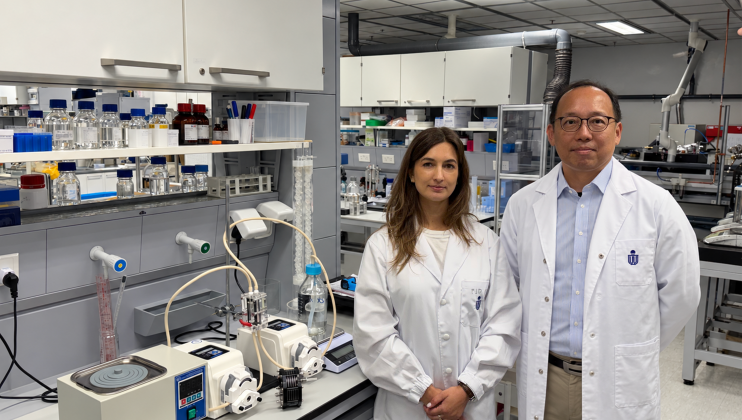
Prof. Lin Yen-Hung, Assistant Professor of the Department of Electronic and Computer Engineering at HKUST (center), Dr. Fion Yeung Sze-Yan, Senior Manager at the State Key Laboratory of Displays and Opto-Electronics (left), Dr. Li Fengzhu, Research Assistant Professor of the Department of Electronic and Computer Engineering at HKUST (right), and other research team members published “Interface-mediated crystallization enables PEDOT:PSS-free all-perovskite tandems with 29.1% efficiency and enhanced durabilit
HKUST Engineering Improves Solar Cell Performance and Durability Through Molecular Interface Engineering
A research team led by Prof. LIN Yen-Hung has contributed to two recently published studies that show molecular interface engineering can unlock major gains in the efficiency and durability of next-generation perovskite tandem solar cells.
The research team is led by Prof. Chen Hao (second left), Assistant Professor in the Department of Computer Science and Engineering (CSE), in collaboration with Prof. Terence Wong (second right), Associate Head and Associate Professor in the Department of Chemical and Biological Engineering, along with team members: CSE PhD students Ma Jiabo (first right) and Li Wenqiang (first left).
HKUST Researchers Develop GenAI Framework for Misalignment-Resistant Virtual Staining to Accelerate Histopathology Workflows
A research team from the School of Engineering has developed a novelGenAI framework that can produce high-fidelity virtually stained images even when training image pairs are imperfectly aligned, paving the way for faster and more tissue-saving histopathology workflows.
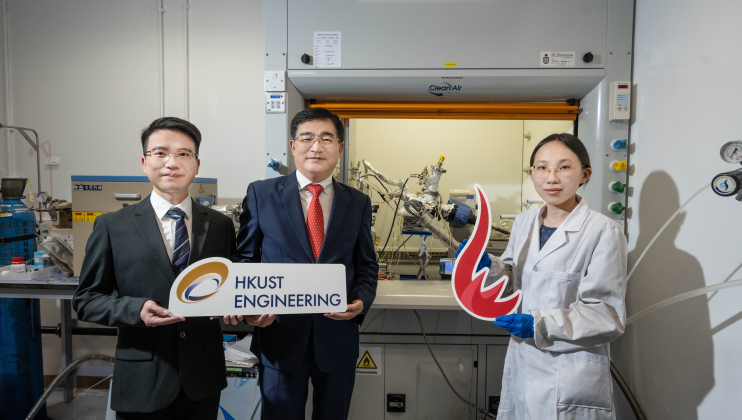
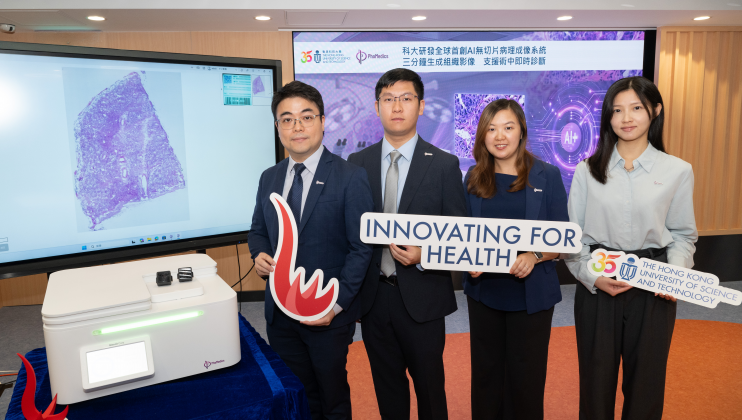
A research team led by Prof. Terence Wong Tsz-Wai (first left), Associate Head and Associate Professor in the Department of Chemical and Biological Engineering at HKUST, together with his medtech startup PhoMedics Limited, has developed Glanzir®, the world’s first AI-enabled, slide-free pathology imaging system. From second left to first right: Dr. Victor Tsang Tsz-Chun, HKUST Bioengineering PhD graduate, Co-Founder and Product Manager of PhoMedics; Dr. Ivy Wong Hei-Man, HKUST Bioengineering PhD graduate, C
HKUST Engineering Develops World’s First AI Slide-Free Pathology Imaging System
A research team led by Prof. Terence WONG Tsz-Wai, together with his medtech start-up PhoMedics Limited, has developed Glanzir®, the world’s first AI-enabled, slide-free pathology imaging system. The system enables direct imaging of fresh tissue without the need for conventional procedures such as freezing, sectioning, and staining, producing histological images in approximately three minutes.
Researchers from HKUST, including Prof. Yang Jinglei (second right), postdoctoral fellows Dr. Liu Biyuan (first left) and Dr. Zhang Yonglin (second left), and PhD candidate Han Yuzi (first right), have discovered the quantum mechanism and rational design principles underlying interfacial polymerization — a breakthrough that advances applications in water purification and microcapsule technology.
HKUST Engineering Uncovers Mechanism Behind Accelerated Interfacial Polymerization
A research team led by Prof. YANG Jinglei has achieved two major breakthroughs in interfacial polymerization, a key technique for preparing advanced functional materials.
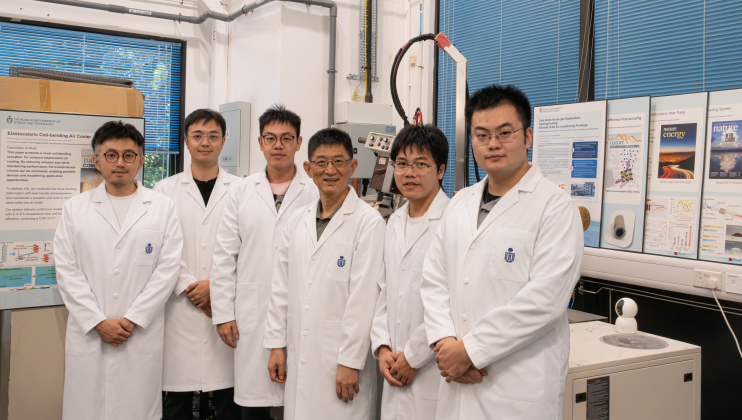
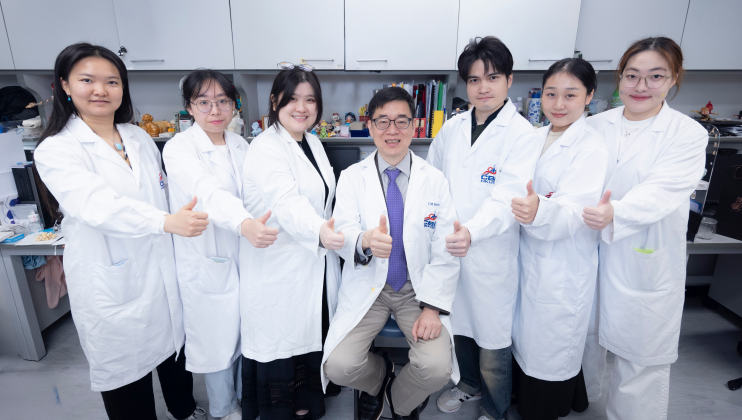
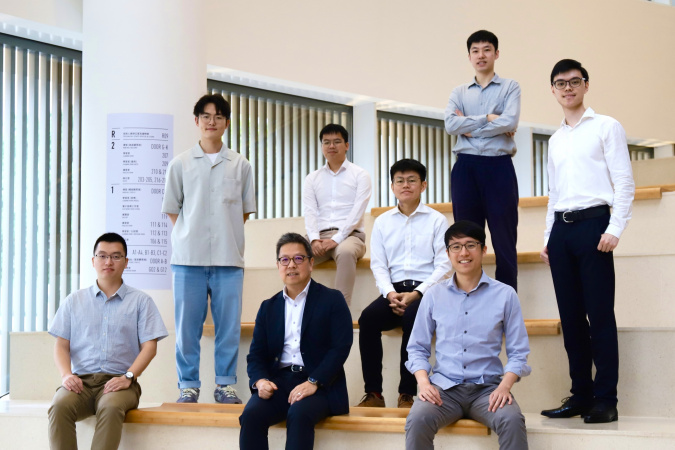
The research conducted by Prof. Zhou Yanguang (left), Dr. Xu Yixin (center), Dr. Xiang Xing (right), and all members of the Microscale Thermal Engineering Lab, bridges the gap between microscopic atomic dynamics and macroscopic ion transport, holding significant engineering value.
HKUST Engineering Unveils Microscopic Mechanism of Fast Ion Transport in Superionic Crystals
A team led by Prof. ZHOU Yanguang discovered a novel mechanism for rapid ion transport in solids, opening new avenues for materials design.
A research team led by Prof. HSING I-Ming (third left), Professor of the Department of Chemical and Biological Engineering (CBE), along with Prof. ZHAI Yuanliang (second right), Associate Professor of the Division of Life Science (LIFS) at HKUST, has developed the world’s first DNA-guided, RNA-targeting CRISPR–Cas system. The photo also includes key team members: Mr. WU Xiaolong (second left), PhD student of CBE; Dr. LAM Wai-Hei (first right), postdoctoral fellow of LIFS; and Dr. CAO Yumeng (first left), po
HKUST Researchers Flip the CRISPR Script to Develop World’s First DNA-Guided Gene Editing Tool for Precise Infectious Disease Diagnosis and Advancing Antiviral Therapies
A research team led by Prof. HSING I-Ming, in collaboration with Prof. ZHAI Yuanliang, has successfully developed the world’s first DNA-guided CRISPR-Cas system capable of programmable RNA targeting and cleavage.
Conceptual illustration showing how the “slow-release solvent” strategy repairs buried interfaces in perovskite thin films. This research was published in Nature Synthesis and featured as the journal’s cover article for the April 2026 issue (Volume 5, Issue 4).
HKUST Engineering Team Co-Pioneers a “Slow-Release Solvent” Strategy to Advance Large-Area Perovskite Photovoltaic Modules
A research team led by Prof. ZHOU Yuanyuan has proposed a crystal-solvate (CSV) seeding strategy with a slow-release solvent function. The solvent molecules are “encapsulated” within the crystal lattice and are gradually released during film annealing, enabling gentle and well-controlled interfacial crystallization.
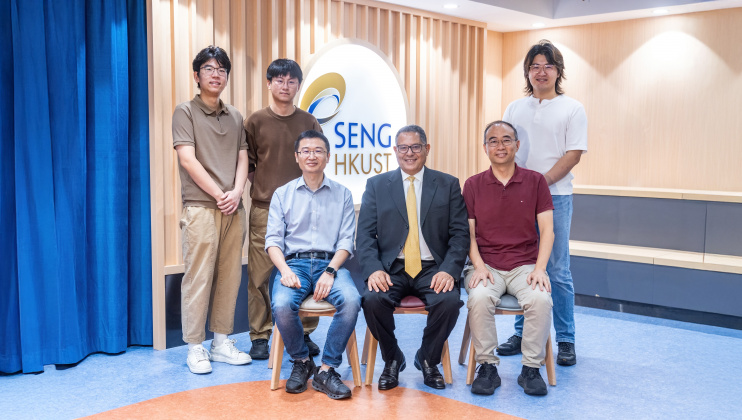
The cross-disciplinary research team includes co-corresponding authors Prof. Qu Jianan (right, back row) and Prof. Julie L. Semmelhack (right, front row), together with co-first authors Mr. Yan Gewei (left, back row) and Dr. Tian Guangnan (right, front row).
HKUST Team Unveils Innovative Technology for Precise Reading and Control of Brain Circuits to Advance Brain Disease Research
A research team led by Prof. QU Jianan has developed a powerful laser control technique. Functioning as a “smart dimmer”, it can selectively adjust the brightness of every pixel during laser scanning, and prevent unintended neural activation.
Prof. Li Xiaomeng (left), Assistant Professor from the Department of Electronic and Computer Engineering and Associate Director of Center for Medical Imaging and Analysis at HKUST, together with her student Li Yi, a PhD candidate from the Department of Electronic and Computer Engineering, develop the novel AI pathology system PRET.
HKUST Engineering Develops Novel AI Pathology System for Accurate Multi-Cancer Diagnosis Without Additional Model Training
A research team led by Prof. LI Xiaomeng has developed a pioneering artificial intelligence (AI) pathology analysis system that can accurately recognize multiple types of cancer using only a minimal number of samples—without requiring any additional training.
Prof. Yoonseob Kim (right), Associate Professor, and Dr. Cheng Xiaolong (left), postdoctoral fellow, from the Department of Chemical and Biological Engineering at HKUST.
HKUST Engineering Develops Advanced Sustainable Energy Storage Technology for High-Performance and Safer Solid-State Lithium Batteries
A research team led by Prof. Yoonseob KIM has successfully synthesized a novel single-crystalline 3D borate covalent organic framework (B-COF), which demonstrates exceptional performance as a solid-state electrolyte.
Prof. Hu Wenqi (right), his postgraduate student Chen Xi (left), and other research team members at HKUST develop the world’s first bio-inspired artificial cilia system, advancing breakthroughs in medical and microrobotics applications.
HKUST Engineering Develops World’s First Bio-Inspired Artificial Cilia System
A research team led by Prof. HU Wenqi has achieved a major scientific breakthrough by developing the first artificial cilia system capable of replicating the fast, complex, three-dimensional motion of natural cilia found throughout the human body.
Title
Innovation and impact
Description
When we blaze trails, move mountains and inspire generations in the evolving realm of engineering
Title
SENG RANKINGS
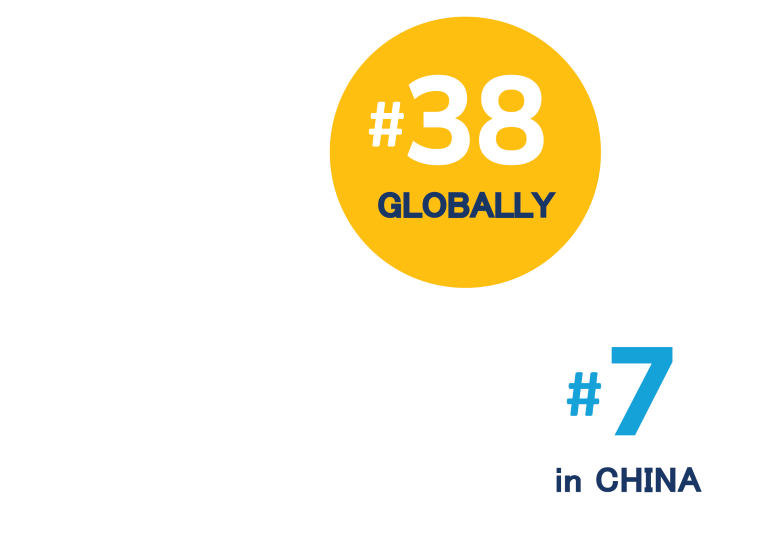
Number 38 globally for Engineering in the Times Higher Education World University Rankings by Subject in 2026

Times Higher Education World University Rankings by Subject 2026

7 in CHINA

Times Higher Education World University Rankings by Subject 2023

Number 38 globally for Engineering in the Times Higher Education World University Rankings by Subject in 2026
Number 40 globally for Engineering and Technology in the QS World University Rankings by Subject in 2026

QS World University Rankings by Subject 2026

Number 1 in Hong Kong for 16 consecutive years for Engineering and Technology in the QS World University Rankings by Subject in 2026

 QS World University Rankings by Subject in 2026

Number 40 globally for Engineering and Technology in the QS World University Rankings by Subject in 2026
Title
STUDYING AT HKUST ENGINEERING
Description
What we offer at different levels of engineering education to help you meet your different aspirations
Title
Departments
Description
The comprehensive range of engineering disciplines within the ambit of SENG
Chemical and Biological Engineering
Civil and Environmental Engineering
Computer Science and Engineering
Electronic and Computer Engineering
Industrial Engineering and Decision Analytics
Mechanical and Aerospace Engineering
Materials
Materials
Title
Feeling blue? Want someone to talk to?
Description
It’s okay to ask for help. The University has a team of professional counselors to render support when you need it.

24/7 HEARing Helpline
Tel: (852) 8208 2688 | Email: counsel@ust.hk

Submodule