
HKUST Engineering Develops First AI Toolkit “GrainBot” to Automate Quantitative Microstructure Analysis

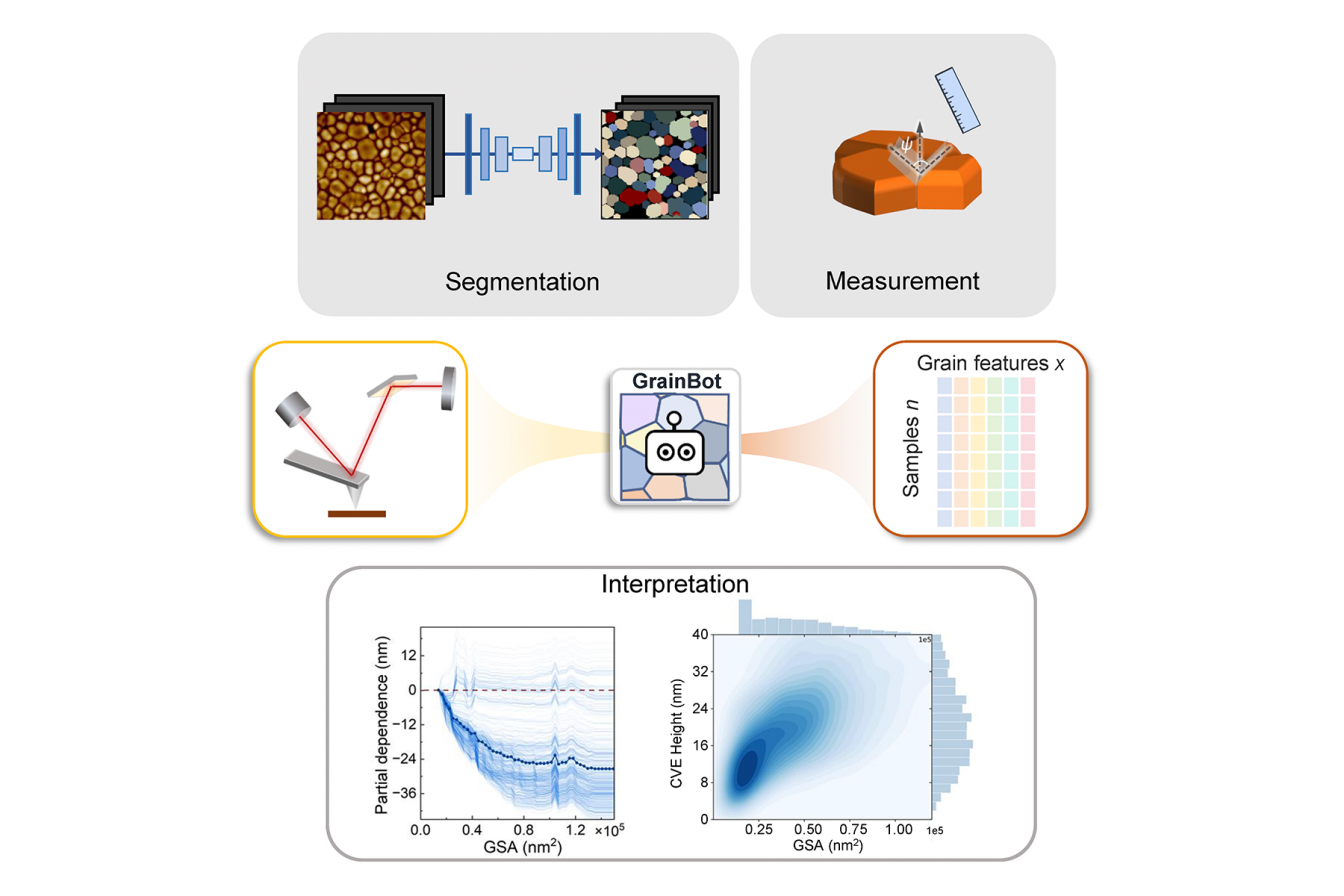
A research team from The Hong Kong University of Science and Technology (HKUST) has developed GrainBot, an AI-enabled toolkit that automatically extracts and quantifies multiple microstructural features from microscopy images. Designed to meet the growing need for data-driven and autonomous research workflows in materials science, the tool provides a systematic method for converting complex image information into quantitative data, thereby accelerating the discovery and development of next-generation materials.
Quantifying microstructure has long been a fundamental challenge across various sub-fields of materials science and engineering. While modern microscopy can capture highly detailed images, the information they contain is often difficult to analyze consistently and at scale. Existing approaches typically focus on identifying simple features or classifying images, offering limited insight into how different microstructural parameters interact. This bottleneck hinders researchers’ ability to fully understand structure–property relationships and slows down the design and optimization of new materials.
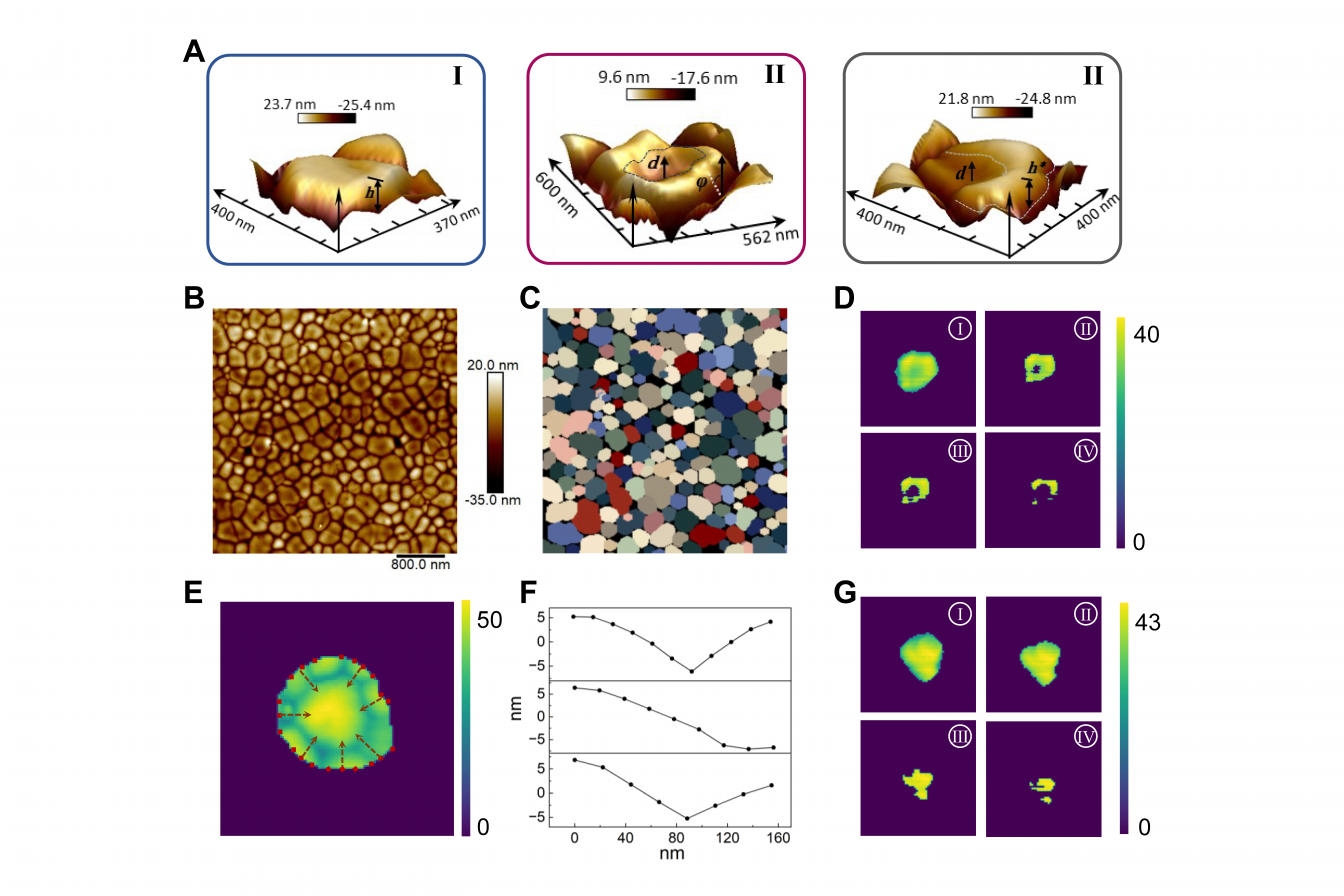
To bridge this gap, the team, led by Prof. ZHOU Yuanyuan, Associate Professor of the Department of Chemical and Biological Engineering at HKUST, designed GrainBot, which provides an integrated solution for segmentation, feature measurement, and correlation analysis. Utilizing a convolutional neural network for precise grain segmentation, the toolkit is complemented by custom algorithms that can measure grain surface area, grain-boundary groove geometry, and surface concavity or convexity volumes. By converting each microscopy image into a rich set of numerical descriptors, GrainBot empowers researchers to build large-scale, standardized microstructure databases rather than relying on qualitative observations alone.
The team validated GrainBot’s capabilities by applying it to metal halide perovskite thin films, a critical material for high-efficiency solar cells. Using atomic force microscopy (AFM) images of samples with diverse bottom surface morphologies, the toolkit constructed a database containing thousands of individual grains, each annotated with multiple microstructural parameters. Subsequent statistical analysis revealed general distribution patterns and previously hard-to-quantify relationships among features such as grain size, groove geometry, and surface roughness.
Beyond statistical analysis, the study also incorporated interpretable machine-learning models to uncover how different microstructural features influence one another. By training gradient-boosted decision tree models on selected grain descriptors and employing interpretation tools such as feature importance profiles and partial dependence plots, the team could examine how parameters like grain surface area and grain-boundary groove angle jointly shape surface concavity depth or ridge height.
Prof. GUO Yike, Provost and Chair Professor of the Department of Computer Science and Engineering and the Department of Electronic and Computer Engineering at HKUST, and a co-author of the study, highlighted the broader relevance of this work for emerging AI-driven scientific infrastructures. “GrainBot illustrates how AI can transform complex microscopy images into structured, reproducible datasets that can be readily shared, re-analyzed and integrated into larger research platforms,” he said. “As scientific workflows become more automated and data-intensive, such toolkits will act as key engines in future autonomous laboratories, continuously feeding standardized microstructure metrics into decision-making systems for materials discovery and optimization.”
Prof. Zhou added that the toolkit aims to support researchers who require consistent, quantitative descriptors of microstructure. “Our goal is to lower the barrier for integrating microscopy characterization into data-driven studies and autonomous laboratory platforms. By offering a unified framework adaptable to different perovskite compositions and processing conditions, GrainBot makes microstructure quantification more accessible—even for those without specialized coding or machine-learning expertise. This systematic view of grain morphology, including grain-boundary grooves, concavities, and convex ridges, is particularly important for understanding and improving the long-term stability of perovskite solar cells,” he said.
In addition to perovskites, GranBot offers a strategic framework for microstructure analysis in other polycrystalline thin films. Moving forward, the team plans to integrate GrainBot with various characterization techniques and explore direct correlations between microstructure and device, as well as long-term stability.
The research, titled “GrainBot: Quantifying Multi-Variable Microstructure Disorder in Materials”, has been published in Matter, a flagship journal of Cell Press.
About The Hong Kong University of Science and Technology
The Hong Kong University of Science and Technology (HKUST) (https://hkust.edu.hk/) is a world-class university known for its innovative education, research excellence, and impactful knowledge transfer. With a holistic and interdisciplinary pedagogy approach, HKUST was ranked 6th in the QS Asia University Rankings 2026, 3rd in the Times Higher Education’s Young University Rankings 2024, and 19th globally and 1st in Hong Kong in the Times Higher Education’s Impact Rankings 2025. Thirteen HKUST subjects were ranked among the world’s top 50 in the QS World University Rankings by Subject 2025, with “Data Science and Artificial Intelligence” coming in 17th worldwide and first in Hong Kong. Our graduates are highly competitive, consistently ranking among the world’s top 30 most sought-after employees. In terms of research and entrepreneurship, over 80% of our work was rated “internationally excellent” or “world leading” in the Research Assessment Exercise 2020 of the Hong Kong’s University Grants Committee. As of January 2026, HKUST members have founded over 1,900 active start-ups, including 10 Unicorns and 21 exits (IPO or M&A).
(This news was originally published by the HKUST Global Engagement and Communications Office here.)