

Revolutionary Open-Source Platform Launched for Electrochemical Impedance Spectroscopy Analysis
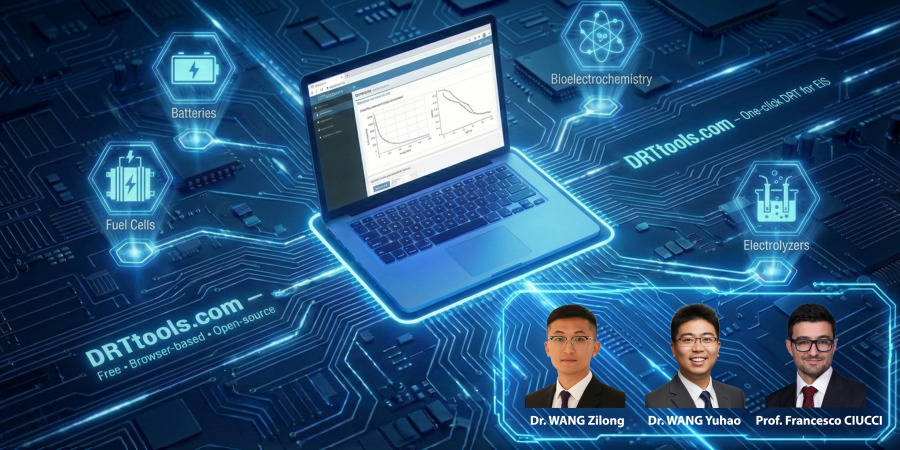
A research team from the Department of Mechanical and Aerospace Engineering has recently developed and released a fully free, open-source, browser-based platform for distribution of relaxation times (DRT) analysis of electrochemical impedance spectroscopy (EIS) data, DRTtools.com.
Their paper on the work, titled “DRTtools: Freely Accessible Distribution of Relaxation Times Analysis for Electrochemical Impedance Spectroscopy” was published online on November 5, 2025, and later appeared in the December 2025 issue of the journal ACS Electrochemistry. Within one month of publication, it quickly became the journal’s most-read paper of 2025. Launched together with the online publication on November 5, 2025, DRTtools.com has received more than 50,000 visits in its first month. As of late February 2026, the platform has recorded approximately 580,000 cumulative visits, with users from over 65 countries and regions, and has processed over 45,000 EIS datasets in total.
The Mechanical and Aerospace Engineering research team included Dr. WANG Zilong (first author), postdoctoral fellow; Dr. WANG Yuhao (first author and corresponding author), postdoctoral fellow and incoming Research Assistant Professor; Prof. Francesco CIUCCI (corresponding author), Adjunct Professor; and PhD graduates Baptiste PY, Adeleke MARADESA, LIU Jiapeng, WAN Ting-Hei and Mattia SACCOCCIO.
EIS is a basic and almost indispensable characterization tool in electrochemistry, but conventional analysis often has a high theoretical barrier, making it difficult for many researchers to interpret their data in depth. DRT is a powerful alternative that can extract rich mechanistic information without requiring strong prior knowledge, but performing the DRT transformation involves challenging mathematics. Existing open-source tools in MATLAB and Python work well in principle, yet many researchers cannot really use them in practice because they lack MATLAB licenses or programming experience. In other words, “open source” has not always meant “truly accessible”.
To address this gap, the research team built DRTtools.com as an open-source, free, one-click, online DRT platform that runs entirely in the browser. Users can upload their EIS data and perform advanced DRT analysis without installing any software or writing any code.
“DRTtools.com reflects our commitment to open science and to making advanced electrochemical analysis more accessible to the global research community,” said Dr. Wang Yuhao, first author and corresponding author of the study. “We hope the platform will support both education and research by enabling more users to perform rigorous DRT analysis with ease.”
The team’s work describing the platform has been published in ACS Electrochemistry as an open-access article, supported by the HKUST Library’s open access initiative, so that researchers and engineers worldwide can read and use it without barriers. By lowering the technical threshold for advanced EIS analysis, DRTtools.com is helping broaden participation in electrochemical research and accelerating data-driven discovery across academia and industry.