Chemical and Biological Engineering

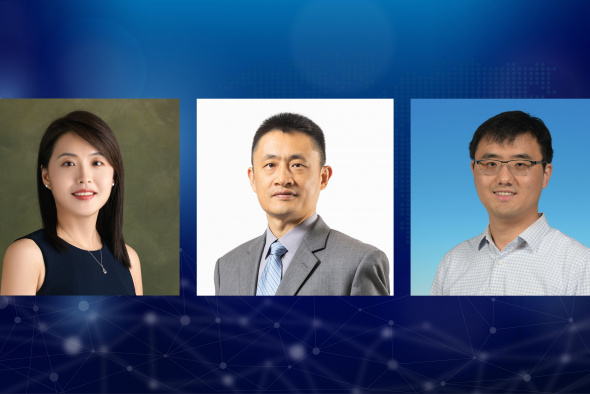
The research team is led by Prof. Chen Hao (second left), Assistant Professor in the Department of Computer Science and Engineering (CSE), in collaboration with Prof. Terence Wong (second right), Associate Head and Associate Professor in the Department of Chemical and Biological Engineering, along with team members: CSE PhD students Ma Jiabo (first right) and Li Wenqiang (first left).
The research team is led by Prof. Chen Hao (second left), Assistant Professor in the Department of Computer Science and Engineering (CSE), in collaboration with Prof. Terence Wong (second right), Associate Head and Associate Professor in the Department of Chemical and Biological Engineering, along with team members: CSE PhD students Ma Jiabo (first right) and Li Wenqiang (first left). 
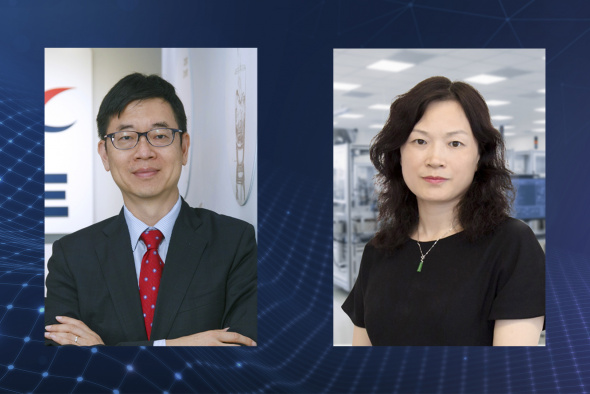
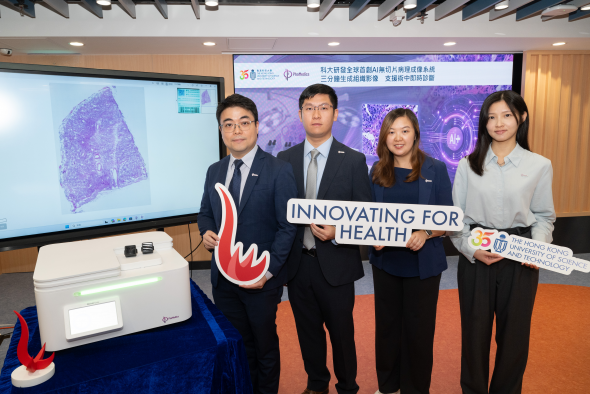
A research team led by Prof. Terence Wong Tsz-Wai (first left), Associate Head and Associate Professor in the Department of Chemical and Biological Engineering at HKUST, together with his medtech start-up PhoMedics Limited, has developed Glanzir®, the world’s first AI-enabled, slide-free pathology imaging system. From second left to first right: Dr. Victor Tsang Tsz-Chun, HKUST Bioengineering PhD graduate, Co-Founder and Product Manager of PhoMedics; Dr. Ivy Wong Hei-Man, HKUST Bioengineering PhD graduate,
A research team led by Prof. Terence Wong Tsz-Wai (first left), Associate Head and Associate Professor in the Department of Chemical and Biological Engineering at HKUST, together with his medtech start-up PhoMedics Limited, has developed Glanzir®, the world’s first AI-enabled, slide-free pathology imaging system. From second left to first right: Dr. Victor Tsang Tsz-Chun, HKUST Bioengineering PhD graduate, Co-Founder and Product Manager of PhoMedics; Dr. Ivy Wong Hei-Man, HKUST Bioengineering PhD graduate, Co-Founder and Chief Imaging Scientist of PhoMedics; and Ms. Lauren Tsui Wai-Kei, HKUST Bioengineering MPhil graduate, Co-Founder and Head of Operations of PhoMedics.  
Generates Histological Images in Just Three Minutes to Support Rapid Intraoperative Diagnosis
Prof. Shao Minhua was honored with the 2026 Energy Technology Division Research Award at the 249th Electrochemical Society Meeting, which was held in Seattle, Washington, US on May 24-28, 2026.
Prof. Shao Minhua was honored with the 2026 Energy Technology Division Research Award at the 249th Electrochemical Society Meeting, which was held in Seattle, Washington, US on May 24-28, 2026. 
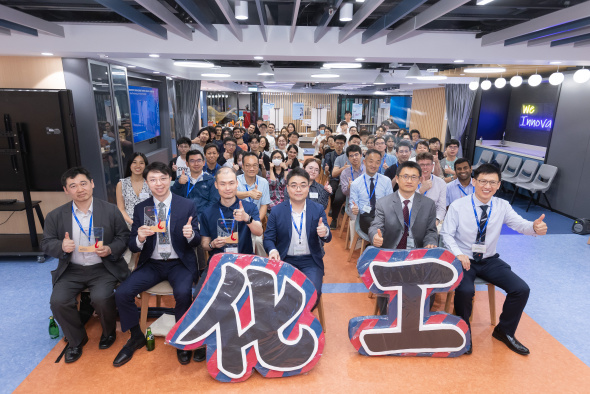
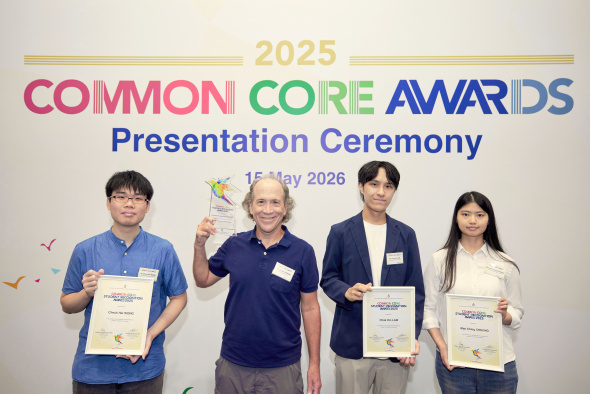
Prof. Andrew Horner (second left) is named the winner of the Common Core Teaching Excellence Award 2025 and Prof. Hnin Yin Yin Nyein (in absentia) is the Honorary Mention awardee. Cheung Man-Ching (first right), Lam Chak-Hin (second right) and Wong Cheuk-Hei (first left) are the Student Recognition Award winners.
Prof. Andrew Horner (second left) is named the winner of the Common Core Teaching Excellence Award 2025 and Prof. Hnin Yin Yin Nyein (in absentia) is the Honorary Mention awardee. Cheung Man-Ching (first right), Lam Chak-Hin (second right) and Wong Cheuk-Hei (first left) are the Student Recognition Award winners. 
A research team led by Prof. Hsing I-Ming (third left), Professor of the Department of Chemical and Biological Engineering (CBE), along with Prof. Zhai Yuanliang (second right), Associate Professor of the Division of Life Science (LIFS) at HKUST, has developed the world’s first DNA-guided, RNA-targeting CRISPR–Cas system. The photo also includes key team members: Mr. Wu Xiaolong (second left), PhD student of CBE; Dr. Lam Wai-Hei (first right), postdoctoral fellow of LIFS; and Dr. Cao Yumeng (first left), po
A research team led by Prof. Hsing I-Ming (third left), Professor of the Department of Chemical and Biological Engineering (CBE), along with Prof. Zhai Yuanliang (second right), Associate Professor of the Division of Life Science (LIFS) at HKUST, has developed the world’s first DNA-guided, RNA-targeting CRISPR–Cas system. The photo also includes key team members: Mr. Wu Xiaolong (second left), PhD student of CBE; Dr. Lam Wai-Hei (first right), postdoctoral fellow of LIFS; and Dr. Cao Yumeng (first left), postdoctoral fellow of CBE. 
Conceptual illustration showing how the “slow-release solvent” strategy repairs buried interfaces in perovskite thin films. This research was published in Nature Synthesis and featured as the journal’s cover article for the April 2026 issue (Volume 5, Issue 4).
Conceptual illustration showing how the “slow-release solvent” strategy repairs buried interfaces in perovskite thin films. This research was published in Nature Synthesis and featured as the journal’s cover article for the April 2026 issue (Volume 5, Issue 4). 
Prof. Yoonseob Kim (right), Associate Professor, and Dr. Cheng Xiaolong (left), postdoctoral fellow, from the Department of Chemical and Biological Engineering at HKUST.
Prof. Yoonseob Kim (right), Associate Professor, and Dr. Cheng Xiaolong (left), postdoctoral fellow, from the Department of Chemical and Biological Engineering at HKUST. 
Prof. Chen Shensheng (left) and PhD student Wu Zongpei (right) simulated the whole process of liquid-liquid phase separation from start to finish, revealing how mussels instantly glue themselves to rocks. Their research holds significant implications for developing instant biocompatible surgical glues and programmable smart materials.
Prof. Chen Shensheng (left) and PhD student Wu Zongpei (right) simulated the whole process of liquid-liquid phase separation from start to finish, revealing how mussels instantly glue themselves to rocks. Their research holds significant implications for developing instant biocompatible surgical glues and programmable smart materials. 
Providing Implications for Instant Biocompatible Surgical Glues
Recognizing Exceptional Contributions to Bioelectronics