
Research & Innovation

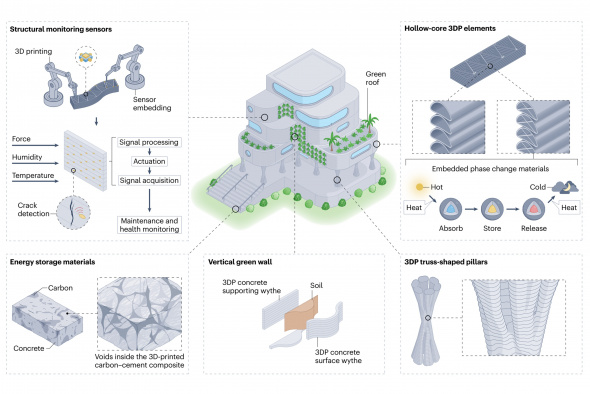
3D-printed concrete building features and advanced functions
3D-printed concrete building features and advanced functions 
Groundbreaking Advances in 3D Printing and Biochar Innovations
Innovative catalytic mechanism for selective biomass oxidation: The schematic illustrates the in-situ generation of surface-bound hydroxyl radicals on low-valence copper (Cu⁰/Cu⁺) sites, enabling highly selective carbonyl oxidation using only ambient air and water. This green catalytic pathway eliminates the need for traditional oxidants and represents a significant advancement in sustainable biomass conversion.
Innovative catalytic mechanism for selective biomass oxidation: The schematic illustrates the in-situ generation of surface-bound hydroxyl radicals on low-valence copper (Cu⁰/Cu⁺) sites, enabling highly selective carbonyl oxidation using only ambient air and water. This green catalytic pathway eliminates the need for traditional oxidants and represents a significant advancement in sustainable biomass conversion. 
Transforming Biomass into High-Value Chemicals with Enhanced Efficiency and Sustainability
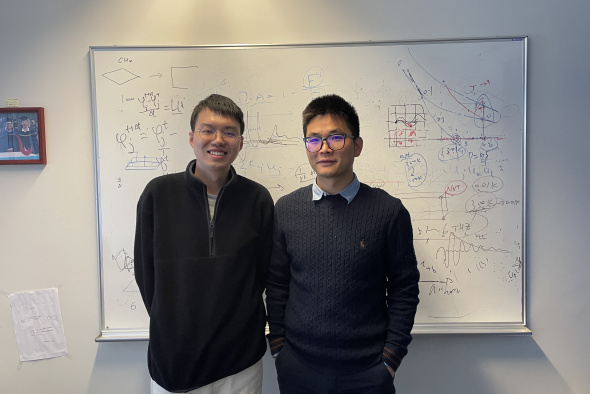
Prof. Zhou Yanguang (right) and his PhD student Liu Wenxiang (left) proposed a rigorous concept based on the Onsager reciprocal theorem to describe the thermal transport behaviors in superionic crystals.
Prof. Zhou Yanguang (right) and his PhD student Liu Wenxiang (left) proposed a rigorous concept based on the Onsager reciprocal theorem to describe the thermal transport behaviors in superionic crystals. 
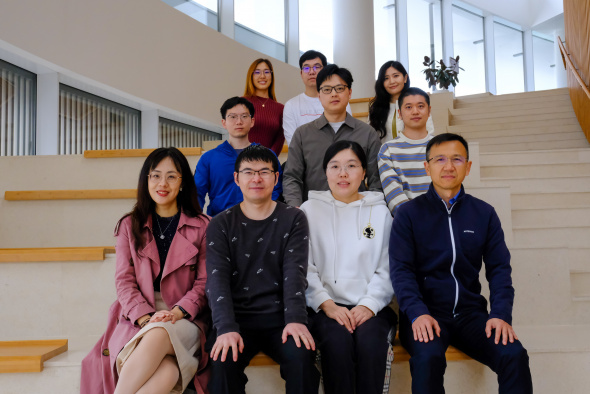
Prof. Wang Yiwen (first left, front row) from the Department of Electronic and Computer Engineering and the Department of Chemical and Biological Engineering, and Prof. Liu Kai (first right, front row) from the Division of Life Science and the Department of Chemical and Biological Engineering, along with his research team
Prof. Wang Yiwen (first left, front row) from the Department of Electronic and Computer Engineering and the Department of Chemical and Biological Engineering, and Prof. Liu Kai (first right, front row) from the Division of Life Science and the Department of Chemical and Biological Engineering, along with his research team 
Revealing Mechanisms of Functional Circuit Reconstruction Following Central Nervous System Injury
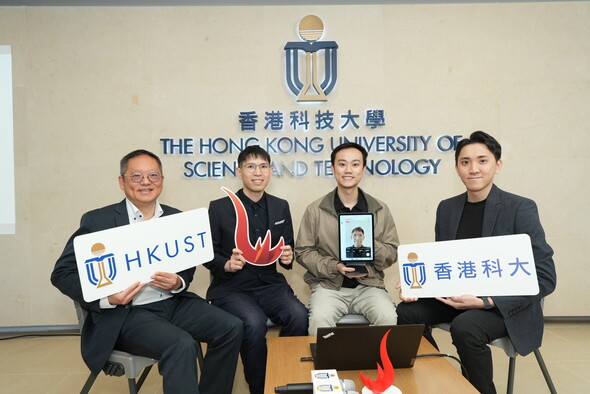
PanopticAI’s co-founders Dr. Kyle Wong (second right), Dr. Nick Chin (second left) and Mr. Teric Chan (first right), and their advisor Prof. Richard So (first left), Associate Dean of Engineering (Research and Graduate Studies).
PanopticAI’s co-founders Dr. Kyle Wong (second right), Dr. Nick Chin (second left) and Mr. Teric Chan (first right), and their advisor Prof. Richard So (first left), Associate Dean of Engineering (Research and Graduate Studies). 
Transforming Smartphones into Medical-Grade Vital Sign Monitors
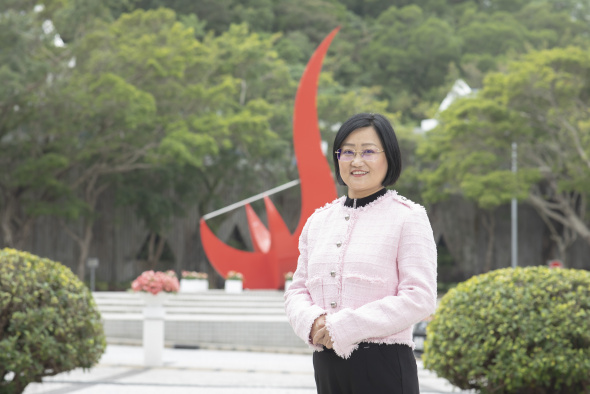
Prof. Alicia An Kyoungjin
Prof. Alicia An Kyoungjin 
The in-house pH-responsive mucin extract investigated in Prof. Hsing I-Ming’s study shows promise in the development of multifunctional wound dressings for accelerating the healing process of infected wounds.
The in-house pH-responsive mucin extract investigated in Prof. Hsing I-Ming’s study shows promise in the development of multifunctional wound dressings for accelerating the healing process of infected wounds. 
Two joint labs led by Prof. Kevin Chen (left) and Prof. Shao Minhua (right) received funding in the Research Grants Council’s co-funding mechanism on joint laboratories with the Chinese Academy of Sciences.
Two joint labs led by Prof. Kevin Chen (left) and Prof. Shao Minhua (right) received funding in the Research Grants Council’s co-funding mechanism on joint laboratories with the Chinese Academy of Sciences. 
Driving Research in Microelectronics and Hydrogen Energy