
Biomedical Engineering

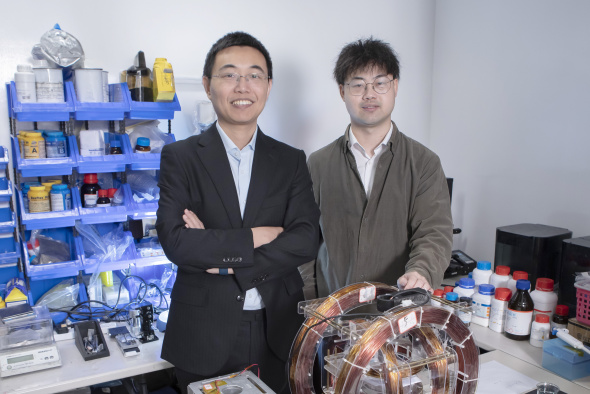
A research team led by Prof. Hsing I-Ming (center), Professor of the Department of Chemical and Biological Engineering at HKUST, has developed TEMPO, a thermodynamically programmed one-pot CRISPR platform for rapid, point-of-care nucleic acid testing. Mr. Wu Xiaolong (third right) and Ms. Li Yanan (first left), PhD students from the Department of Chemical and Biological Engineering, are the co-first authors of this study.
A research team led by Prof. Hsing I-Ming (center), Professor of the Department of Chemical and Biological Engineering at HKUST, has developed TEMPO, a thermodynamically programmed one-pot CRISPR platform for rapid, point-of-care nucleic acid testing. Mr. Wu Xiaolong (third right) and Ms. Li Yanan (first left), PhD students from the Department of Chemical and Biological Engineering, are the co-first authors of this study. 
Offering a More Convenient Solution for Future Infectious Disease Surveillance and Genetic Screening
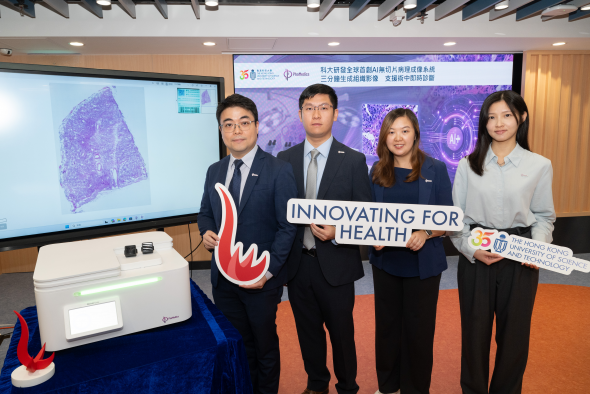
A research team led by Prof. Terence Wong Tsz-Wai (first left), Associate Head and Associate Professor in the Department of Chemical and Biological Engineering at HKUST, together with his medtech start-up PhoMedics Limited, has developed Glanzir®, the world’s first AI-enabled, slide-free pathology imaging system. From second left to first right: Dr. Victor Tsang Tsz-Chun, HKUST Bioengineering PhD graduate, Co-Founder and Product Manager of PhoMedics; Dr. Ivy Wong Hei-Man, HKUST Bioengineering PhD graduate,
A research team led by Prof. Terence Wong Tsz-Wai (first left), Associate Head and Associate Professor in the Department of Chemical and Biological Engineering at HKUST, together with his medtech start-up PhoMedics Limited, has developed Glanzir®, the world’s first AI-enabled, slide-free pathology imaging system. From second left to first right: Dr. Victor Tsang Tsz-Chun, HKUST Bioengineering PhD graduate, Co-Founder and Product Manager of PhoMedics; Dr. Ivy Wong Hei-Man, HKUST Bioengineering PhD graduate, Co-Founder and Chief Imaging Scientist of PhoMedics; and Ms. Lauren Tsui Wai-Kei, HKUST Bioengineering MPhil graduate, Co-Founder and Head of Operations of PhoMedics.  
Generates Histological Images in Just Three Minutes to Support Rapid Intraoperative Diagnosis
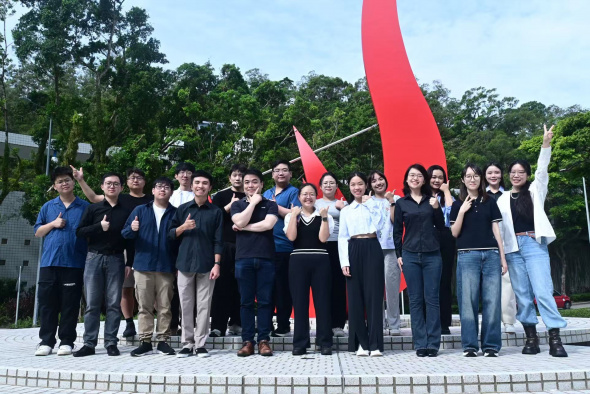
Prof. Terence Wong (front row, fifth left) and students in the Department of Chemical and Biological Engineering
Prof. Terence Wong (front row, fifth left) and students in the Department of Chemical and Biological Engineering 
Four Projects Led by SENG Faculty Members
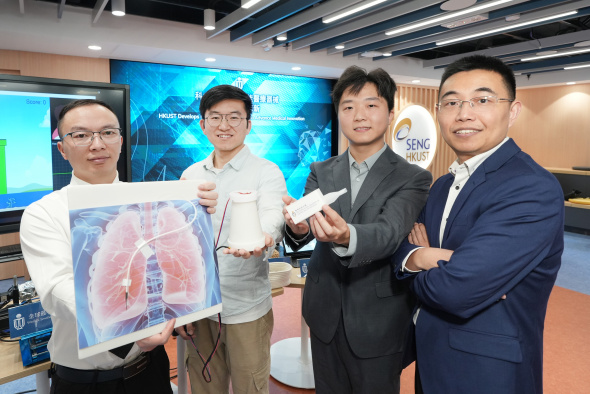
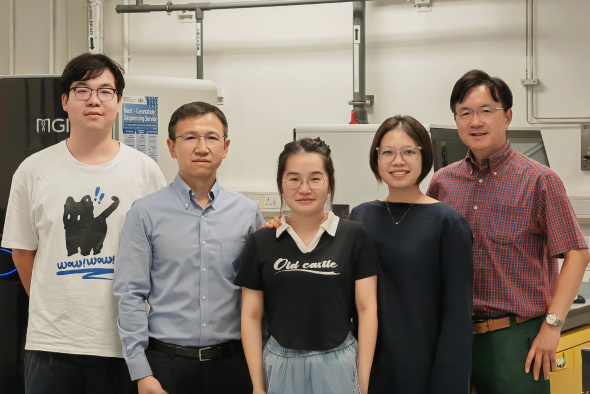
Group photo of Prof. Shen Yajing (first right) and his research team: Dr. Zhang Tieshan (first left), Tang Yifeng (second left) and Ren Hao (second right).
Group photo of Prof. Shen Yajing (first right) and his research team: Dr. Zhang Tieshan (first left), Tang Yifeng (second left) and Ren Hao (second right). 
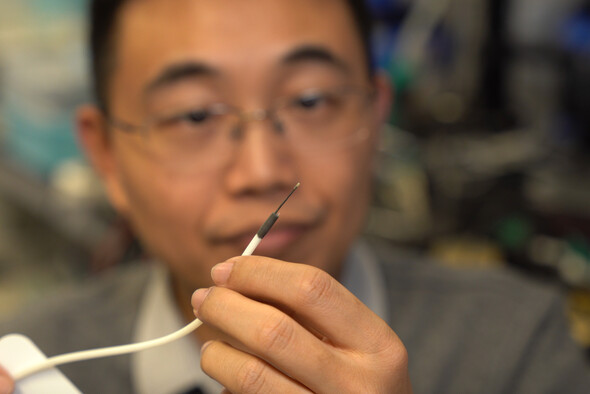
Researchers from the School of Engineering of HKUST develop the world’s smallest multifunctional biomedical robot which has a slim profile of just 0.95 mm.
Researchers from the School of Engineering of HKUST develop the world’s smallest multifunctional biomedical robot which has a slim profile of just 0.95 mm.  
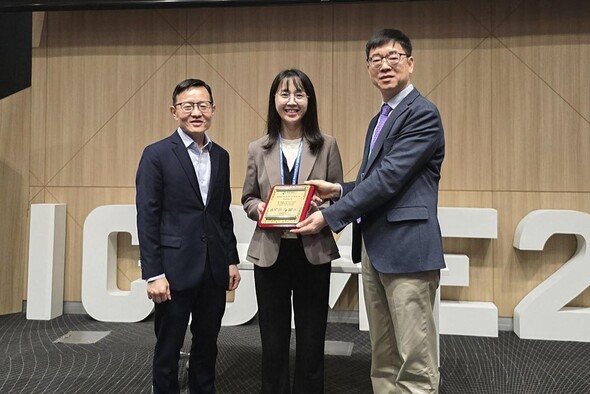
Prof. Lim Chwee-Teck (left), chair of the 18th International Conference on Biomedical Engineering 2024 (ICBME 2024), and Prof. Hsing I-Ming (right), President of the Asia Pacific Biomedical Engineering Consortium (APBEC) and Professor of Chemical and Biological Engineering at HKUST, presented the APBEC Young Scholar Award to Prof. Hnin Y. Y. Nyein at ICBME 2024.
Prof. Lim Chwee-Teck (left), chair of the 18th International Conference on Biomedical Engineering 2024 (ICBME 2024), and Prof. Hsing I-Ming (right), President of the Asia Pacific Biomedical Engineering Consortium (APBEC) and Professor of Chemical and Biological Engineering at HKUST, presented the APBEC Young Scholar Award to Prof. Hnin Y. Y. Nyein at ICBME 2024. 
Corresponding authors: Prof. Qu Jianan (first right) from the Department of Electronic and Computer Engineering (ECE), and Prof. Liu Kai (second left) from the Division of Life Science (LIFS); co-first authors: ECE PhD graduate Dr. Wu Wanjie (second right), ECE PhD student He Yingzhu (center), and LIFS PhD student Chen Yujun (first left)
Corresponding authors: Prof. Qu Jianan (first right) from the Department of Electronic and Computer Engineering (ECE), and Prof. Liu Kai (second left) from the Division of Life Science (LIFS); co-first authors: ECE PhD graduate Dr. Wu Wanjie (second right), ECE PhD student He Yingzhu (center), and LIFS PhD student Chen Yujun (first left) 
The in-house pH-responsive mucin extract investigated in Prof. Hsing I-Ming’s study shows promise in the development of multifunctional wound dressings for accelerating the healing process of infected wounds.
The in-house pH-responsive mucin extract investigated in Prof. Hsing I-Ming’s study shows promise in the development of multifunctional wound dressings for accelerating the healing process of infected wounds. 
Prof. Shen Yajing (left) and co-first author Dr. Yang Xiong (right) with the magnetic actuation platform for microswimmer control in front.