Press Releases

Prof. Nancy Ip (center), HKUST President; together with Prof. Tim Cheng Kwang-Ting (second right), HKUST Vice‑President for Research and Development; pose for a group photo with three core members of the project: Prof. Su Hui (second left), Chair Professor in the Department of Civil and Environmental Engineering and Global STEM Professor at HKUST; Prof. Zhang Limin (first right), Chair Professor and Head of the same department; and Prof. Zhai Chengxing (first left), Associate Professor in the Division of Em
Prof. Nancy Ip (center), HKUST President; together with Prof. Tim Cheng Kwang-Ting (second right), HKUST Vice‑President for Research and Development; pose for a group photo with three core members of the project: Prof. Su Hui (second left), Chair Professor in the Department of Civil and Environmental Engineering and Global STEM Professor at HKUST; Prof. Zhang Limin (first right), Chair Professor and Head of the same department; and Prof. Zhai Chengxing (first left), Associate Professor in the Division of Emerging Interdisciplinary Areas. 
Witnessed by HKUST President Prof. Nancy Ip (first left), and Dr. LI Ning, Founder of the Li-Ning Brand and Chairman of the Li-Ning Group (first right), HKUST Vice-President for Research and Development Prof. Tim Cheng (second left), and Vice President and Chief Sports Officer of Li-Ning Group Mr. Hong Yuru (second right) unveil the plaque for the HKUST–Li-Ning Joint Laboratory for Sports Science and Technologies.
Witnessed by HKUST President Prof. Nancy Ip (first left), and Dr. LI Ning, Founder of the Li-Ning Brand and Chairman of the Li-Ning Group (first right), HKUST Vice-President for Research and Development Prof. Tim Cheng (second left), and Vice President and Chief Sports Officer of Li-Ning Group Mr. Hong Yuru (second right) unveil the plaque for the HKUST–Li-Ning Joint Laboratory for Sports Science and Technologies. 
A research team led by Prof. Hsing I-Ming (third left), Professor of the Department of Chemical and Biological Engineering (CBE), along with Prof. Zhai Yuanliang (second right), Associate Professor of the Division of Life Science (LIFS) at HKUST, has developed the world’s first DNA-guided, RNA-targeting CRISPR–Cas system. The photo also includes key team members: Mr. Wu Xiaolong (second left), PhD student of CBE; Dr. Lam Wai-Hei (first right), postdoctoral fellow of LIFS; and Dr. Cao Yumeng (first left), po
A research team led by Prof. Hsing I-Ming (third left), Professor of the Department of Chemical and Biological Engineering (CBE), along with Prof. Zhai Yuanliang (second right), Associate Professor of the Division of Life Science (LIFS) at HKUST, has developed the world’s first DNA-guided, RNA-targeting CRISPR–Cas system. The photo also includes key team members: Mr. Wu Xiaolong (second left), PhD student of CBE; Dr. Lam Wai-Hei (first right), postdoctoral fellow of LIFS; and Dr. Cao Yumeng (first left), postdoctoral fellow of CBE. 
The officiating guests include the Honourable Mrs. Regina Ip Lau Suk-Yee (third left), Convenor of the Non-official Members of the Executive Council of the HKSAR Government; Dr. Stephen Wong Yuen-Shan (third right), Head of the Chief Executive’s Policy Unit of the HKSAR Government; Prof. Wu Ji (second right), President of the Chinese Society of Space Research; Prof. Bernard Foing (second left), Executive Director of the COSPAR International Lunar Exploration Working Group and Chairman of the Lunar Explorers
The officiating guests include the Honourable Mrs. Regina Ip Lau Suk-Yee (third left), Convenor of the Non-official Members of the Executive Council of the HKSAR Government; Dr. Stephen Wong Yuen-Shan (third right), Head of the Chief Executive’s Policy Unit of the HKSAR Government; Prof. Wu Ji (second right), President of the Chinese Society of Space Research; Prof. Bernard Foing (second left), Executive Director of the COSPAR International Lunar Exploration Working Group and Chairman of the Lunar Explorers Society; Prof. Charles Ng Wang-Wai (first left), HKUST Vice-President for Institutional Advancement; and Prof. Gao Yang (first right), Director of HKSREC and Professor in the Department of Mechanical and Aerospace Engineering at HKUST.  
Uniting Beijing-Shanghai-Hong Kong Research Strengths to Launch Space Intelligence Innovation Hub
Conceptual illustration showing how the “slow-release solvent” strategy repairs buried interfaces in perovskite thin films. This research was published in Nature Synthesis and featured as the journal’s cover article for the April 2026 issue (Volume 5, Issue 4).
Conceptual illustration showing how the “slow-release solvent” strategy repairs buried interfaces in perovskite thin films. This research was published in Nature Synthesis and featured as the journal’s cover article for the April 2026 issue (Volume 5, Issue 4). 
The cross-disciplinary research team includes co-corresponding authors Prof. Qu Jianan (right, back row) and Prof. Julie L. Semmelhack (right, front row), together with co-first authors Mr. Yan Gewei (left, back row) and Dr. Tian Guangnan (right, front row).
The cross-disciplinary research team includes co-corresponding authors Prof. Qu Jianan (right, back row) and Prof. Julie L. Semmelhack (right, front row), together with co-first authors Mr. Yan Gewei (left, back row) and Dr. Tian Guangnan (right, front row). 
Prof. Li Xiaomeng (left), Assistant Professor from the Department of Electronic and Computer Engineering and Associate Director of Center for Medical Imaging and Analysis at HKUST, together with her student Li Yi, a PhD candidate from the Department of Electronic and Computer Engineering, develop the novel AI pathology system PRET.
Prof. Li Xiaomeng (left), Assistant Professor from the Department of Electronic and Computer Engineering and Associate Director of Center for Medical Imaging and Analysis at HKUST, together with her student Li Yi, a PhD candidate from the Department of Electronic and Computer Engineering, develop the novel AI pathology system PRET. 
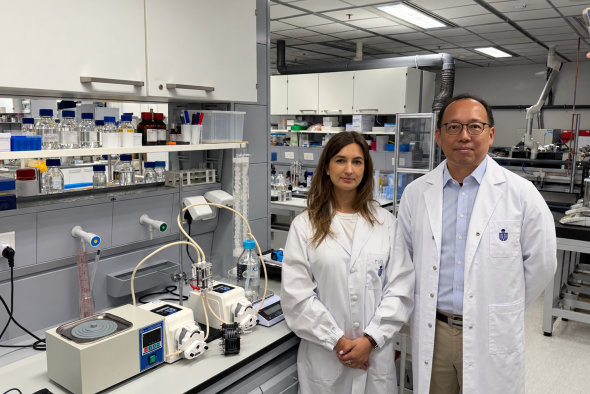
Prof. Yoonseob Kim (right), Associate Professor, and Dr. Cheng Xiaolong (left), postdoctoral fellow, from the Department of Chemical and Biological Engineering at HKUST.
Prof. Yoonseob Kim (right), Associate Professor, and Dr. Cheng Xiaolong (left), postdoctoral fellow, from the Department of Chemical and Biological Engineering at HKUST. 
Prof. Hu Wenqi (right), his postgraduate student Chen Xi (left), and other research team members at HKUST develop the world’s first bio-inspired artificial cilia system, advancing breakthroughs in medical and microrobotics applications.
Prof. Hu Wenqi (right), his postgraduate student Chen Xi (left), and other research team members at HKUST develop the world’s first bio-inspired artificial cilia system, advancing breakthroughs in medical and microrobotics applications. 
Advancing Breakthroughs in Medical and Microrobotics Applications
Prof. Chen Shensheng (left) and PhD student Wu Zongpei (right) simulated the whole process of liquid-liquid phase separation from start to finish, revealing how mussels instantly glue themselves to rocks. Their research holds significant implications for developing instant biocompatible surgical glues and programmable smart materials.
Prof. Chen Shensheng (left) and PhD student Wu Zongpei (right) simulated the whole process of liquid-liquid phase separation from start to finish, revealing how mussels instantly glue themselves to rocks. Their research holds significant implications for developing instant biocompatible surgical glues and programmable smart materials. 
Providing Implications for Instant Biocompatible Surgical Glues