Press Releases

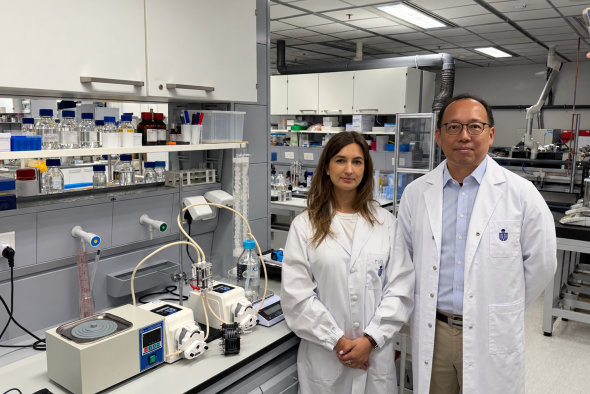
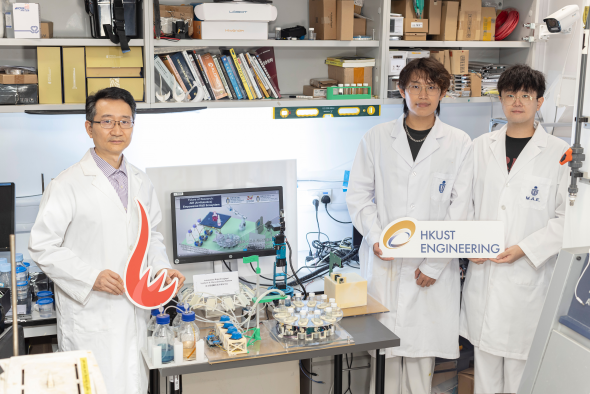
The research team is led by Prof. Chen Hao (second left), Assistant Professor in the Department of Computer Science and Engineering (CSE), in collaboration with Prof. Terence Wong (second right), Associate Head and Associate Professor in the Department of Chemical and Biological Engineering, along with team members: CSE PhD students Ma Jiabo (first right) and Li Wenqiang (first left).
The research team is led by Prof. Chen Hao (second left), Assistant Professor in the Department of Computer Science and Engineering (CSE), in collaboration with Prof. Terence Wong (second right), Associate Head and Associate Professor in the Department of Chemical and Biological Engineering, along with team members: CSE PhD students Ma Jiabo (first right) and Li Wenqiang (first left). 
HKUST’s Cheng Kar-Shun Robotics Institute announces the establishment of its Industrial Alliance, alongside the inaugural CKSRI Industrial Summit. The initiative brings together leaders from academia and industry to strengthen connections between HKUST research teams and a broad network of industry partners.
HKUST’s Cheng Kar-Shun Robotics Institute announces the establishment of its Industrial Alliance, alongside the inaugural CKSRI Industrial Summit. The initiative brings together leaders from academia and industry to strengthen connections between HKUST research teams and a broad network of industry partners. 
Collaboration in Support of the National “AI+ Initiative”
A research team led by Prof. Terence Wong Tsz-Wai (first left), Associate Head and Associate Professor in the Department of Chemical and Biological Engineering at HKUST, together with his medtech start-up PhoMedics Limited, has developed Glanzir®, the world’s first AI-enabled, slide-free pathology imaging system. From second left to first right: Dr. Victor Tsang Tsz-Chun, HKUST Bioengineering PhD graduate, Co-Founder and Product Manager of PhoMedics; Dr. Ivy Wong Hei-Man, HKUST Bioengineering PhD graduate,
A research team led by Prof. Terence Wong Tsz-Wai (first left), Associate Head and Associate Professor in the Department of Chemical and Biological Engineering at HKUST, together with his medtech start-up PhoMedics Limited, has developed Glanzir®, the world’s first AI-enabled, slide-free pathology imaging system. From second left to first right: Dr. Victor Tsang Tsz-Chun, HKUST Bioengineering PhD graduate, Co-Founder and Product Manager of PhoMedics; Dr. Ivy Wong Hei-Man, HKUST Bioengineering PhD graduate, Co-Founder and Chief Imaging Scientist of PhoMedics; and Ms. Lauren Tsui Wai-Kei, HKUST Bioengineering MPhil graduate, Co-Founder and Head of Operations of PhoMedics.  
Generates Histological Images in Just Three Minutes to Support Rapid Intraoperative Diagnosis
Researchers from HKUST, including Prof. Yang Jinglei (second right), postdoctoral fellows Dr. Liu Biyuan (first left) and Dr. Zhang Yonglin (second left), and PhD candidate Han Yuzi (first right), have discovered the quantum mechanism and rational design principles underlying interfacial polymerization — a breakthrough that advances applications in water purification and microcapsule technology.
Researchers from HKUST, including Prof. Yang Jinglei (second right), postdoctoral fellows Dr. Liu Biyuan (first left) and Dr. Zhang Yonglin (second left), and PhD candidate Han Yuzi (first right), have discovered the quantum mechanism and rational design principles underlying interfacial polymerization — a breakthrough that advances applications in water purification and microcapsule technology. 
Enabling Predictable Microcapsule Design with AI
Prof. Kei May Lau, Research Professor of the Division of Emerging Interdisciplinary Areas and Professor Emeritus of the Department of Electronic and Computer Engineering at HKUST (second right), has received the prestigious 2026 Heinrich Welker Award in the semiconductor field. Prof. Lau attended the award presentation ceremony held in Kumamoto, Japan, on May 25.
Prof. Kei May Lau, Research Professor of the Division of Emerging Interdisciplinary Areas and Professor Emeritus of the Department of Electronic and Computer Engineering at HKUST (second right), has received the prestigious 2026 Heinrich Welker Award in the semiconductor field. Prof. Lau attended the award presentation ceremony held in Kumamoto, Japan, on May 25. 
First Awardee Based on Achievements Accomplished in Hong Kong/China
Prof. Zhang Limin, Head and Chair Professor of the Department of Civil and Environmental Engineering at HKUST, receives a Certificate of Merit at the Fourth National Award for Excellence in Innovation.
Prof. Zhang Limin, Head and Chair Professor of the Department of Civil and Environmental Engineering at HKUST, receives a Certificate of Merit at the Fourth National Award for Excellence in Innovation.  
Recognizing Contributions to National Disaster Prevention and Mitigation
The research team will explore bio-inspired actuation technologies, illustration on new generation of orbital robotics, capable of performing precise tasks such as grasping, assembly, and obstacle avoidance.
The research team will explore bio-inspired actuation technologies, illustration on new generation of orbital robotics, capable of performing precise tasks such as grasping, assembly, and obstacle avoidance. 
Pooling Scientific Strengths from Beijing, Shanghai and Hong Kong to Drive Space Manufacturing and Debris-Mitigation Innovation
The HKUST-CalmCar Physical AI Innovation Center inauguration ceremony
The HKUST-CalmCar Physical AI Innovation Center inauguration ceremony 
Ushering in a New Era of Physical Intelligence
Distinguished guests learn about the latest HKUST inventions.
Distinguished guests learn about the latest HKUST inventions. 
Advancing Research Commercialization and Building a Vibrant I&T Ecosystem
The research conducted by Prof. Zhou Yanguang (left), Dr. Xu Yixin (center), Dr. Xiang Xing (right), and all members of the Microscale Thermal Engineering Lab, bridges the gap between microscopic atomic dynamics and macroscopic ion transport, holding significant engineering value.
The research conducted by Prof. Zhou Yanguang (left), Dr. Xu Yixin (center), Dr. Xiang Xing (right), and all members of the Microscale Thermal Engineering Lab, bridges the gap between microscopic atomic dynamics and macroscopic ion transport, holding significant engineering value. 
Driving Next-Generation Thermoelectric Conversion for Cleaner Energy