
Making The Leap: From HKUST to Silicon Valley

An HKUST graduate with a BEng in Computer Science, Jeffrey LEE is now a software engineer at Amazon in California—a career launched by an email he nearly deleted.
Around the turn of 2017, in his final year at HKUST, Jeffrey Lee Chun-on took an unusual step after receiving an email: he deleted it.
The message, sent by the University’s Career Center, advertised a one-year internship in Silicon Valley—the destination he had aspired to reach since taking a course two years earlier. Yet he initially dismissed the opportunity. “I was angry enough to lose all my drive,” he says. In 2015, a Silicon Valley internship arranged through a Cyberport partnership had fallen through because of a visa issue, despite several rounds of interviews and an offer. “I really didn’t want to face the same thing again.”
The opportunity remained open because the same email had also reached his then girlfriend, now his wife, who was studying computer science at HKUST. She encouraged him to apply once more. “Applying costs nothing,” he recalls concluding. “If you don’t get in, you don’t get in. If you do, then you think about it.”
He got in. Today, Jeffrey is a software engineer at Amazon, living in Mountain View—home to Google’s headquarters—and working in neighboring Sunnyvale.
Early encounters with HKUST
Jeffrey’s connection with HKUST began before he enrolled. As a Secondary 5 and 6 student, he attended International Physics Olympiad training on campus after participating in the Hong Kong Physics Olympiad, with lectures on Saturday mornings followed by afternoon tutorials. His first impression was of “a school full of learned scholars who were dedicated in nurturing students.”
His interest in computing began at home, where he watched his father, a mechanical engineer, use AutoCAD to solve problems and even design his bunk bed. Yet in Secondary 4, Jeffrey chose physics, chemistry and biology rather than information and communication technology—a decision that remained “a thorn” until the Olympiad training clarified his direction. “I discovered I had no talent for physics,” he says.
Jeffrey entered the School of Engineering in 2012 determined to study computer science. In his first year, he joined the Dean’s Club, then a new initiative for students who had earned at least one 5** in the DSE. When members were asked to introduce themselves through a personal story, Jeffrey spoke about taking an iPhone application course alongside working professionals after Secondary 6. Despite having no coding experience, he developed an app and published it on the App Store. “It was unwatchable,” he says.
The experience nevertheless opened a door. The School introduced him to alumni Angus LUK and Sum WONG, whose fledgling venture would become EventXtra, now EventX. In need of iPhone applications, they hired Jeffrey part-time, and he began skipping Tuesday classes to work from their North Point office. “I naively thought I could write code,” he says. “Doing commercial work turned out to be another matter.” With the pressure falling largely on the full-time team, he was free to learn. “I found it exhilarating. It was real-world problem solving.”
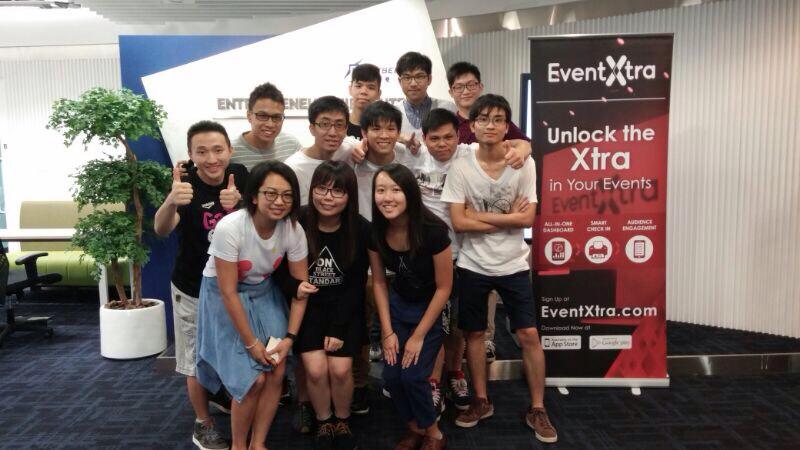
Jeffrey with co-founders Angus Luk, Sum Wong, and the EventXtra team at Cyberport.
A Silicon Valley dream takes shape
In the spring semester of 2014–15, Jeffrey took COMP 4911 IT Entrepreneurship with Prof. Gary CHAN Shueng-Han of the Department of Computer Science and Engineering (CSE). Prof. Chan framed entrepreneurship as a matter of opportunity and being in “the right place at the right time”, describing Silicon Valley as a place where capital, talent, openness to newcomers and an appetite for innovation converged.
For Jeffrey, Silicon Valley became “the end point of a pilgrimage for a software engineer”—a place he needed to experience for himself. “Was the opportunity Gary described real, and was there anything in it for me?”
That ambition suffered a setback in his third year when the Cyberport internship fell through after his classmates had already secured their placements. Scrambling for an alternative, he arranged a gap year in 2016 at Oursky, a local app studio. For the first few months, he struggled to regain his motivation—“you feel you have lost something you had been chasing”—but three demanding client projects, frequent midnight finishes and lessons beyond those he had learned at EventXtra ultimately strengthened his technical skills. “Looking backward, you can connect the dots.”
For his final-year project (FYP), supervised by Prof. Desmond TSOI, Assistant Professor of Engineering Education in CSE at that time, Jeffrey developed a multiplayer virtual reality game controlled by a Leap Motion hand sensor. Despite his demanding schedule, Prof. Tsoi met the team for at least an hour each week—“extremely busy, yet still willing to guide students.”
When the integration stalled and the team considered changing topics, Prof. Tsoi brought them together with another group facing the same challenge. “FYP is normally winner-takes-all. He reframed it: the tool under the hood can be the same, but the problem you solve and the value you deliver are different.” Both teams succeeded and earned nominations, with Jeffrey’s project receiving a Best FYP award. He later nominated Prof. Tsoi for HKUST’s highest teaching honor, the Michael G. Gale Medal, which Prof. Tsoi received in 2022.
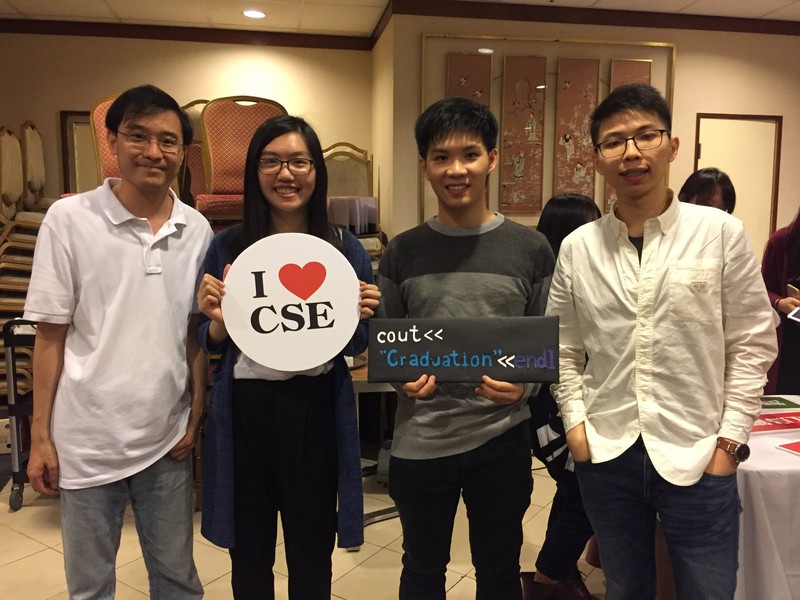
Prof. Desmond Tsoi (first left) with Jeffrey (second right) and his final-year project team members including his wife Alice (second left), celebrating their award-winning VR game project.
The award itself did not lead to job offers, but the collaboration skills and friendships proved enduring—one member of the team (first right) later became his best friend.
He also credits three and a half years of hall life—including half a year on exchange—with teaching him “how to take responsibility for my own life.” With his family home in Tuen Mun, far from campus, and no one setting his schedule, he learned to choose his own activities, exchanges and jobs—and, occasionally, the roommates.
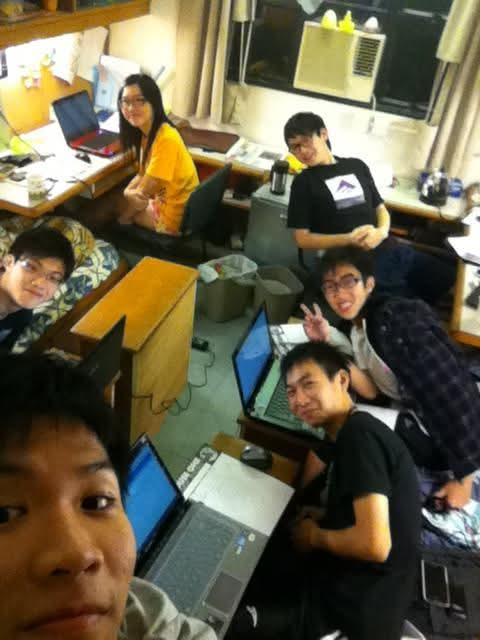
Jeffrey hanging out with hallmates in student accommodation, a vibrant community experience that taught him independence.
Turning a Silicon Valley opportunity into reality
Once his visa was approved, Jeffrey arrived in Silicon Valley in July 2017, sharing an Airbnb room with eight people before searching for housing without a metro or an Uber budget. “The work I could handle comfortably, thanks to EventXtra and Oursky. Housing and transport were extremely hard.”
Nine months later, he won a one-in-three chance in the US work visa lottery. After his trainee visa expired, he waited in Hong Kong until the expedited application was approved, returning in July 2019.
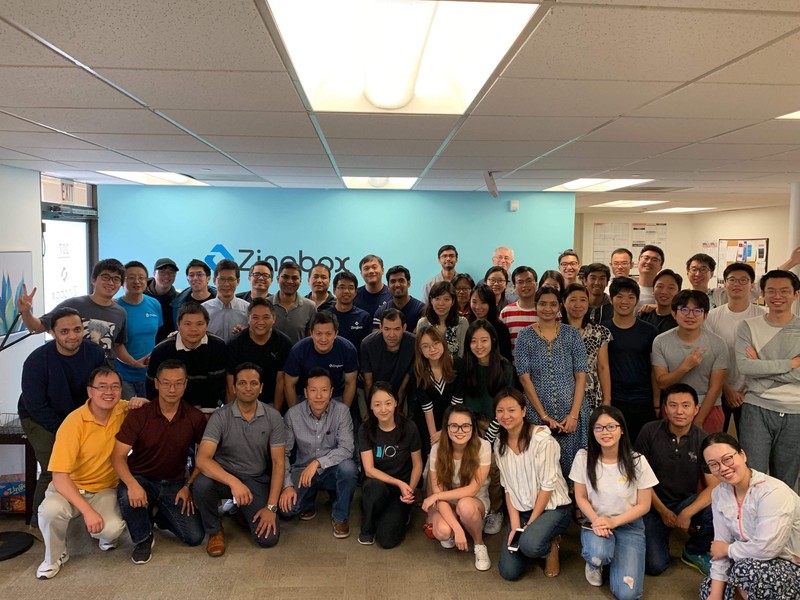
Jeffrey with colleagues at Zingbox, the Silicon Valley IoT cybersecurity start-up later acquired by Palo Alto Networks.
After Palo Alto Networks acquired his start-up employer, the faster pace, higher expectations and limited immigration support prompted a move. Amazon hired him in 2020; he later joined a satellite team and worked on Amazon’s first satellite launch. “That kind of opportunity is rare—maybe SpaceX, Blue Origin, Amazon.”
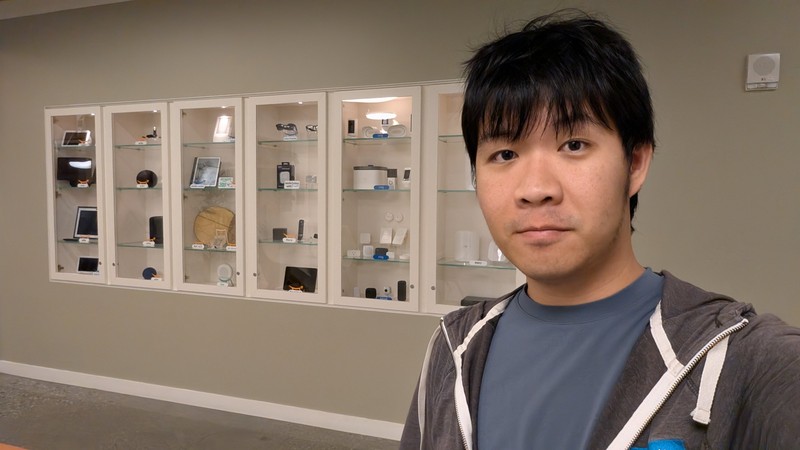
Jeffrey at Amazon Lab126 in Sunnyvale, California, where he works as a software engineer contributing to satellite and hardware initiatives.
Success is no longer about titles. One colleague moved from felling trees to Amazon after creating an Android app for the work. “There is more than one path. Success now is whether I can use what I have to help someone with the same dream.”
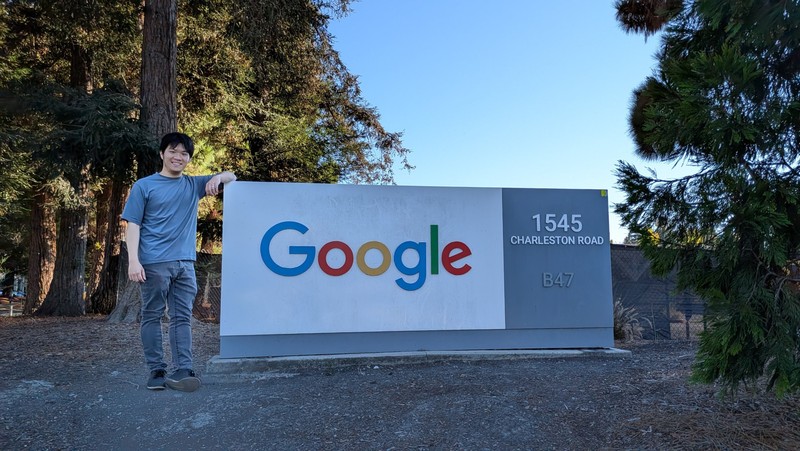
Jeffrey visiting the Google campus in Mountain View, Silicon Valley, fulfilling his long-held dream of living and working in the heart of global tech innovation.
Is he worried about AI? “If I said no, I would be lying.” Yet AI also creates problems for engineers to solve, including hallucinations and security. “Traditional coding will largely be replaced. The curiosity and the passion to create and to solve real-world problems will not change.”
Writing the next chapter
Jeffrey is now recounting the journey in a book due next year, tracing the decade from the email he nearly deleted to this year, when his wife—whom he met on his first day at HKUST—finally joined him in the US after six years apart. “Not exaggerating, everything I have now is because of her.”
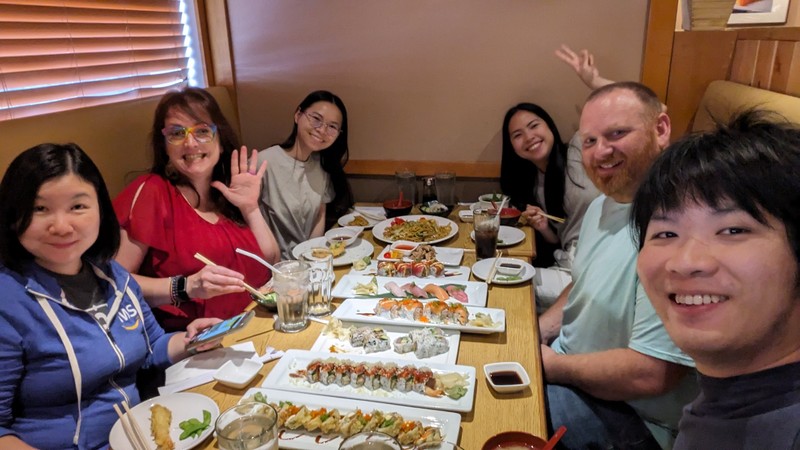
Jeffrey (front right) enjoying dinner with close friends in California.
The lesson he carries forward echoes Prof. Chan’s classroom: “Preparing yourself can feel like a waste of time, but that is when you are waiting for an opportunity. When it appears, take it, even if you are not in perfect shape. Progress starts with action.”
HKUST gave him the vision, practical experience and opportunity to move forward. Letting them pass, he says, “would have been me choosing not to, not the world failing to give.” His message is simple: “Keep looking for opportunities. Don’t stop.”
A motto he chose from a card at HKUST Information Day in 2022 still guides him: “Change is the only constant. Make the leap and believe in it.”