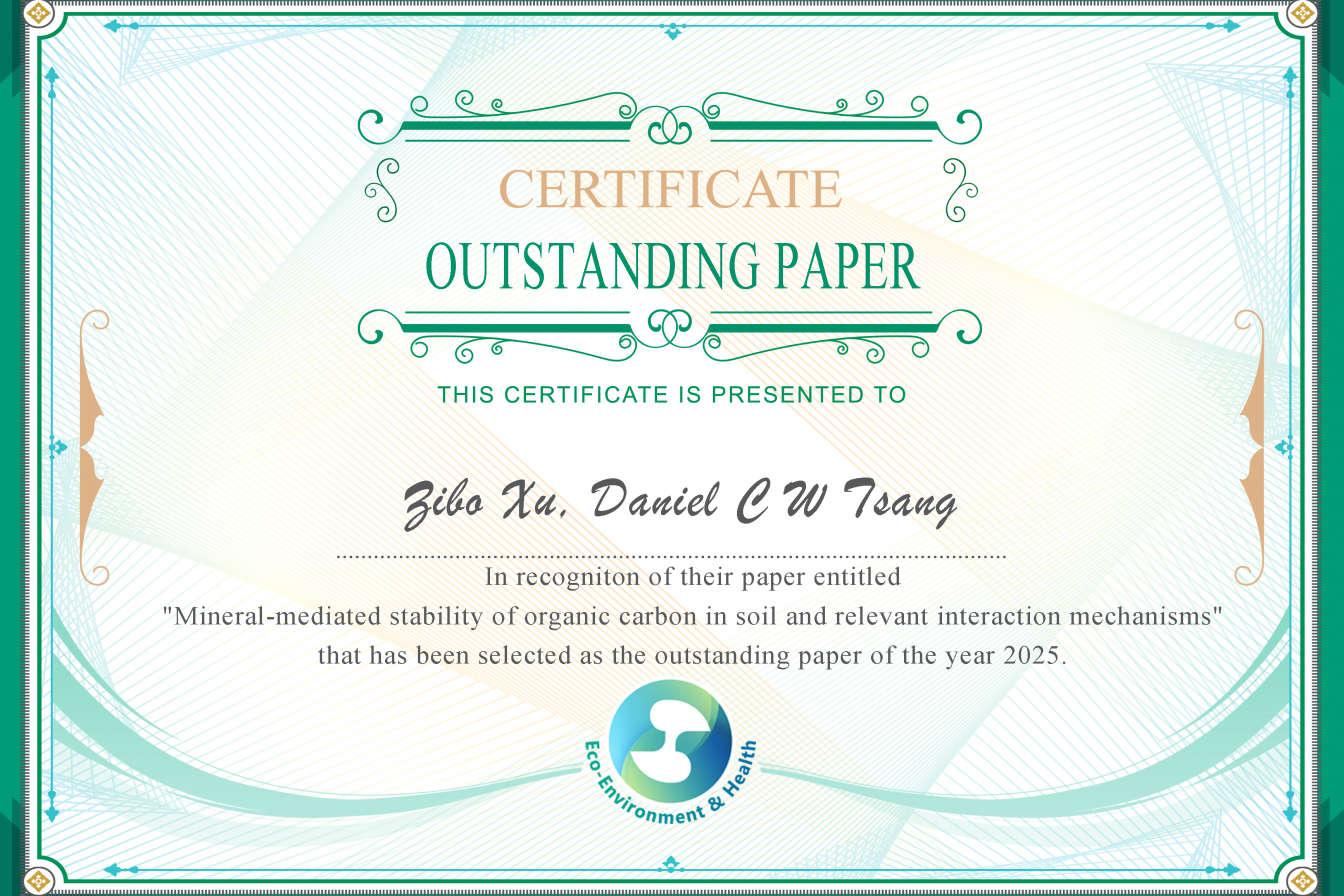
Prof. Dan TSANG Won Outstanding Paper Award of Eco-Environment & Health

A paper co-authored by Prof. Dan TSANG, Professor of the Department of Civil and Environmental Engineering (CIVL) and Director of the Research Center on Decarbonization Technology, and Dr. XU Zibo, Research Assistant Professor of the CIVL Department, was named an Outstanding Paper of the journal Eco-Environment & Health (EEH) in the year 2025. The paper is titled “Mineral-mediated stability of organic carbon in soil and relevant interaction mechanisms”, published in EEH in March 2024 (Volume 3, Issue 1). Only five papers were selected for the honor each year.
The EEH journal, ranked 8/374 in Environmental Sciences in Journal Citation Reports with an impact factor of 17.6, is a highly respected platform for research on the frontiers of ecology, environment, and health, as well as related disciplines. EEH focuses on the concept of “One Health” to promote green and sustainable development, dealing with the interactions among ecology, environment, and health, and the underlying mechanisms and interventions.
While soil serves as the Earth’s largest terrestrial carbon sink, preventing trapped carbon from decomposing and re-entering the atmosphere as greenhouse gases has remained a complex global puzzle. In this work, they reveal that interactions between organic carbon and soil minerals are the primary drivers of long-term carbon stability. By elucidating these intricate mineral-organic mechanisms, the study sheds light on how carbon can be safely locked. These insights represent a major leap forward for environmental engineering, empowering scientists to develop more accurate models of the Earth’s natural carbon cycle and paving the way for innovative, nature-based solutions to combat climate change.
Related link:
- Award announcement by EEH (in Chinese)