
Computer Science and Engineering PhD Student SHI Yuzhe Awarded NSFC Young Student Basic Research Program Grant
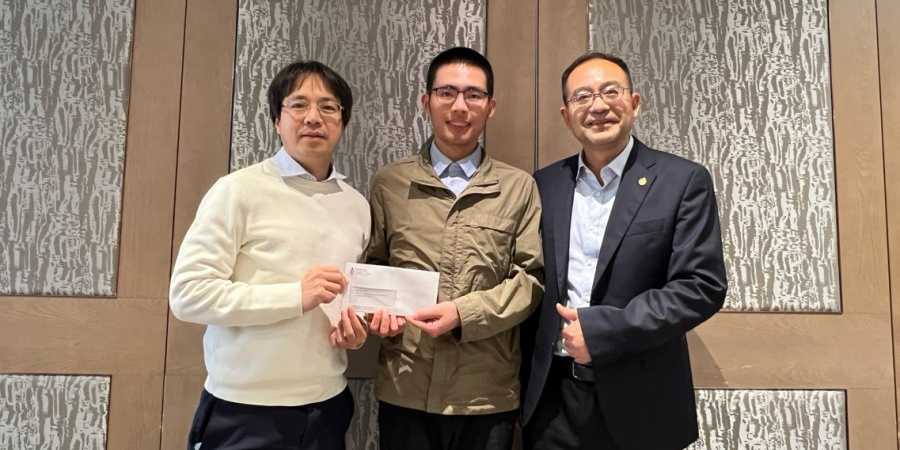
Computer Science and Engineering PhD Student SHI Yuzhe was awarded a grant under the 2025 National Natural Science Foundation of China (NSFC) Young Student Basic Research Program (PhD student), totaling RMB 300,000. He is supervised by Prof. QU Huamin, Dean of the Academy of Interdisciplinary Studies and Chair Professor of the Department of Computer Science and Engineering.
Established in 2023, the NSFC Young Student Basic Research Program (PhD Student) aims to strengthen the training of early-career scholars, encourage independent thinking and innovation, and support their active engagement in scientific research. The grant provides two years of funding to help recipients explore new research directions, broaden their academic perspectives, and enhance their research capabilities as well as project management skills.
This is the first time that this highly competitive scheme is opened to Hong Kong. Yuzhe is one of the two awardees from the School of Engineering, among a total of only six at HKUST. His project, titled “On the Automated Design of Procedural Knowledge Representation: Theories and Algorithms”, will be funded for two years (from January 2026 to December 2027).
The project aims to tackle a key challenge in bringing AI into professional domains: how to turn procedural knowledge, the step-by-step expertise behind real-world tasks, into forms that machines can use effectively. Drawing on declarative knowledge, expert consensus and case archives, and building on a bidirectional optimization framework that combines empirical induction with theoretical deduction, the research will develop theories and algorithms for automatically building structured, verifiable and executable knowledge representations. It will also establish evaluation methods and explore how these representations can work with advanced AI models, with demonstration applications in smart manufacturing and scientific discovery.
The project also involves academic collaboration with leading scholars including Prof. WANG Qining of Peking University and Prof. Philip S. YU of the University of Illinois Chicago.
“This project was inspired by a fundamental dilemma in AI development: general AI techniques aim to cover domains broadly, while domain practitioners require deep and specialized knowledge. Under limited computational resources, this creates a trade-off between breadth and depth. My research seeks to address this challenge by disentangling domain-specific knowledge representation from AI techniques, reducing integration complexity and enabling modular knowledge components to be incorporated into AI systems as needed. I hope this work will help make AI more accessible to domain practitioners and support the broader integration of AI across professional fields,” said Yuzhe.
Related links:
- Department news (April 28, 2026): CSE PhD Student SHI Yu-Zhe Awarded NSFC Young Student Basic Research Project
- SENG news (March 30, 2026): Civil Engineering PhD Student YANG Changyi Awarded NSFC Young Student Basic Research Program Grant