SENG News

The HKUST research team, comprising Dr. Wang Cen (front row), Prof. Su Hui (middle row, left), Prof. Zhai Chengxing (middle row, right), Dr. Yu Shiwei (back row, right), Mo Huisi (back row, left) and Wang Yanjia (back row, center).
The HKUST research team, comprising Dr. Wang Cen (front row), Prof. Su Hui (middle row, left), Prof. Zhai Chengxing (middle row, right), Dr. Yu Shiwei (back row, right), Mo Huisi (back row, left) and Wang Yanjia (back row, center). 
Accelerated Arctic Collapse Forecast Post-2040 Without Emission Cuts
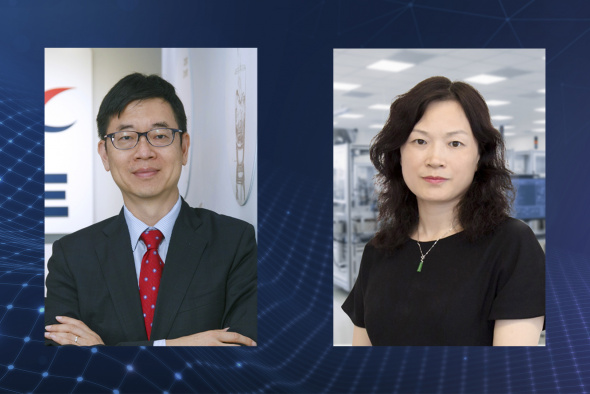
Prof. Andrew Poon (left), Head and Professor of the Department of Electronic and Computer Engineering at HKUST, and PhD student Niu Yue (right) at the Photonic Device Laboratory.
Prof. Andrew Poon (left), Head and Professor of the Department of Electronic and Computer Engineering at HKUST, and PhD student Niu Yue (right) at the Photonic Device Laboratory. 
Advancing Applications in Programmable Photonics, Biosensing, and Lab-On-Chip Technologies
A group photo of five HKUST scholars who are leading the international “Hong Kong Operation Robot” project. From left to right: Prof. Walter Wang Zhe, Associate Professor of the Department of Civil and Environmental Engineering; Prof. Duan Molong, Assistant Professor of the Department of Mechanical and Aerospace Engineering; Prof. Shi Ling, a Professor in both the Department of Electronic and Computer Engineering and the Department of Chemical and Biological Engineering; Prof. Gao Yang, Professor of the Dep
A group photo of five HKUST scholars who are leading the international “Hong Kong Operation Robot” project. From left to right: Prof. Walter Wang Zhe, Associate Professor of the Department of Civil and Environmental Engineering; Prof. Duan Molong, Assistant Professor of the Department of Mechanical and Aerospace Engineering; Prof. Shi Ling, a Professor in both the Department of Electronic and Computer Engineering and the Department of Chemical and Biological Engineering; Prof. Gao Yang, Professor of the Department of Mechanical and Aerospace Engineering and Prof. Sun Qingping, Chair Professor of the Department of Mechanical and Aerospace Engineering. 
Contributing to National Chang’E-8 Lunar Exploration and Advancing Hong Kong’s Aerospace Science and Technology
Prof. Lu Mengqian (left) and Dr. Cheng Tat-Fan (right) from the Department of Civil and Environmental Engineering at HKUST unraveled a key summertime atmospheric pattern that is undergoing dramatic changes due to climate change, promising to accelerate subseasonal precipitation extremes and shorten the window for disaster preparedness across the world.
Prof. Lu Mengqian (left) and Dr. Cheng Tat-Fan (right) from the Department of Civil and Environmental Engineering at HKUST unraveled a key summertime atmospheric pattern that is undergoing dramatic changes due to climate change, promising to accelerate subseasonal precipitation extremes and shorten the window for disaster preparedness across the world. 
Groundbreaking Research Reveals Cascading Risks to Food, Water, and Energy Systems
The inauguration of SKL-CRCC is officiated by Prof. Nancy Ip, HKUST President (third right); Prof. Jin-Guang Teng, PolyU President (third left); Prof. Charles Ng Wang-Wai, HKUST Vice-President for Institutional Advancement, Director of SKL-CRCC and CLP Holdings Professor of Sustainability (second right); Prof. Wong Wing-Tak, PolyU Deputy President and Provost (second left); Prof. Li Xiangdong, PolyU Dean of Faculty of Construction and Environment, Director of SKL-CRCC and Director of RICRI (first left); and
The inauguration of SKL-CRCC is officiated by Prof. Nancy Ip, HKUST President (third right); Prof. Jin-Guang Teng, PolyU President (third left); Prof. Charles Ng Wang-Wai, HKUST Vice-President for Institutional Advancement, Director of SKL-CRCC and CLP Holdings Professor of Sustainability (second right); Prof. Wong Wing-Tak, PolyU Deputy President and Provost (second left); Prof. Li Xiangdong, PolyU Dean of Faculty of Construction and Environment, Director of SKL-CRCC and Director of RICRI (first left); and Prof. Yue Qingrui, Chairman of the Academic Committee of SKL-CRCC (first right). 
Gathering Global Experts for Symposium to Tackle Challenges of Climate Change
An HKUST research team led by Prof. Hu Wenqi (left third) and Prof. Xu Qin (third right) develops soft composites with non-reciprocal responses through shear-jamming transitions.
An HKUST research team led by Prof. Hu Wenqi (left third) and Prof. Xu Qin (third right) develops soft composites with non-reciprocal responses through shear-jamming transitions. 
Providing Life-Saving Solution in Emergency Situations
A research team led by Prof. Qu Jianan, Professor of the Department of Electronic and Computer Engineering, School of Engineering, HKUST, has introduced a groundbreaking technique that can capture high-resolution images of the awake mice brain in a near non-invasive manner. The advancement promises deeper insights into human brain function in both healthy and diseased conditions.
A research team led by Prof. Qu Jianan, Professor of the Department of Electronic and Computer Engineering, School of Engineering, HKUST, has introduced a groundbreaking technique that can capture high-resolution images of the awake mice brain in a near non-invasive manner. The advancement promises deeper insights into human brain function in both healthy and diseased conditions. 
Group photo of the research team: Prof. Abhishek K. Srivastava (second right), corresponding author of the study; Liao Zebing (center), PhD student and first author of the study; as well as co-authors including postdoctoral fellow Dr. Maksym Prodanov (first right), PhD students Mallem Kumar (second left) and Song Jianxin (first left). Mr Liao holds a red emitting QR-LED sample.